
FBIF Creatine Keynote Recap
I presented at FBIF 2026 last week. Here's what the data is telling us about creatine and why the window for the industry to act is right now.
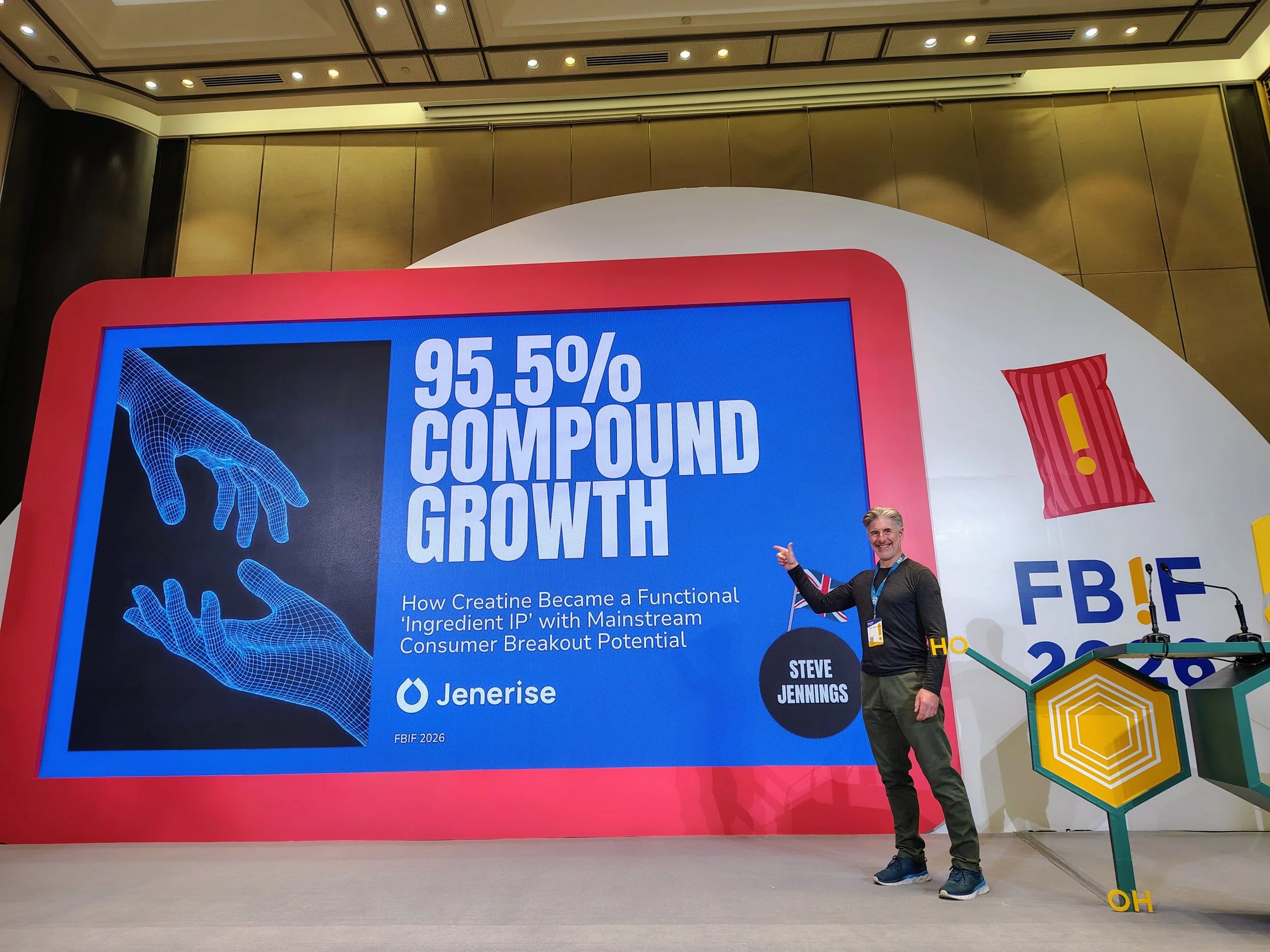
I stood on stage in Hangzhou and opened with a number: 95.5% compound annual growth. Not for some shiny new biotech compound discovered last Tuesday. For creatine. An ingredient I first brought to market at the Barcelona Olympics in 1992. An ingredient that, for three decades, sat quite comfortably inside the world of sport nutrition and largely went nowhere beyond it.
That number stopped a few people in their tracks. It was meant to.
Because here's the thing (and I said this plainly in the room!!), we weren't wrong about creatine back in the early nineties. We were just looking at the wrong horizon. We filed the patent in 1993 (WO-1994/017794A1, if you want to look it up). We knew this ingredient had extraordinary potential. We simply couldn't have predicted that the moment it would truly break out wouldn't come for another three decades, and that when it did, it would arrive not through elite sport but through TikTok, women's health communities, and the cognitive performance conversation.
That's not a failure of the science. The science was always there. It's a lesson in how categories actually mature and a reminder that the biggest opportunities often look obvious only in hindsight.
The numbers from the room
Let me give you the data as I laid it out, because I think the scale of it is still not landing properly across the industry sometimes.
In 2025, 41 million people globally were supplementing creatine daily. By 2030, that number is projected to reach 116 million. Global production of creatine monohydrate is set to grow from 45,000 tonnes today to over 126,000 tonnes by the end of the decade, tracking at a 23% CAGR.
The market value tells a similar story. The creatine supplement category sits at $1.37 billion today. By 2030, it's forecast to reach $4.21 billion. And crucially, those figures only account for powders and gummies. They don't touch ready-to-drink, functional foods, fortified dairy, cereals, or the dozens of other formats now entering the market. The real number is considerably larger, and we can't fully see it yet.
For context: the protein supplement category, which took forty years to build, currently sits at $52.8 billion. Creatine is where protein was before it crossed into everyday grocery. The difference is that creatine has the science, the social proof, and the consumer demand arriving simultaneously, rather than sequentially.
Asia-Pacific is the fastest-growing region at 27.5% CAGR, with North America close behind at 25.1%. But the piece that I think changes everything for anyone building in this space is China. China now manufactures 84% of the world's creatine supply. It is not just a manufacturing story; Douyin and Xiaohongshu are driving B2C demand domestically at pace, while Chinese manufacturers are simultaneously innovating faster than anyone in the B2B ingredient space. If you're not thinking carefully about what China's dominance of this supply chain means for your formulation strategy over the next five years, you should be.
Who is actually buying creatine right now?
This is where I think a lot of brands and manufacturers are still getting it wrong, and I want to be direct about it.
The assumption that creatine consumers are predominantly young men who train five days a week is simply not supported by the data anymore. Per SPINS, 36% of creatine buyers in 2024 were women. The fastest growing segment isn't the gym demographic… It's the 50 to 64 age group, where repeat purchase rates are running at 49.6%. These are not casual experimenters. These are people who have discovered something that works and are committed to it.
The clinical evidence behind that behaviour is solid. Brain-mood health is now the fastest-growing claim in the creatine category, up 86%. Women's health, neuroprotection, bone health, preventing sarcopenia, and cognitive function are all areas where the peer-reviewed literature (680+ studies across 45 years of published research) is pointing in the same direction. We're not talking about fringe science. We're talking about 13,500 participants across 552 safety studies. The foundation is there. The consumer has worked it out. The industry is now playing catch-up.
The format shift is happening whether you're ready or not
The format data hits the hardest, IMO.
Gummies are up 129% year-on-year in dollar sales. Powders, still dominant at 80.4% market share, are growing at 53%. The category is not cannibalising itself… It's expanding. New formats are reaching people who would never have opened a tub of powder in their lives. We're seeing creatine in cereals, puddings, protein bars, carbonated sodas, and coffee pods. The 2026 ready-to-consume creatine landscape looks almost unrecognisable compared to five years ago.
But there is a technical problem sitting at the centre of all of this, and it's one the whole category needs to solve honestly: no liquid-stable creatine technology currently exists at commercial scale. Creatine plus water converts to creatinine (a waste product) through a simple hydrolysis reaction. That means every RTD claiming to contain effective creatine needs to be held to account on stability, dose delivery, and shelf life. This is not a small point. It's the point on which the credibility of the entire functional beverage creatine opportunity rests.
The brands getting this right will define the category. The ones cutting corners will borrow their credibility and, eventually, cost us all.
Where we are in the adoption curve
The framing I used in my presentation was Geoffrey Moore's "Crossing the Chasm" because I genuinely think it's the most useful lens for understanding where creatine sits right now.
From 1992 to 2024, creatine lived in the early market: biohackers, elite athletes, sports nutrition enthusiasts. That's roughly 12% of the addressable population. Between 2025 and 2028 (where we are right now), we're in the early majority phase, reaching active nutrition consumers and health-motivated buyers. That's 30% of the market.
From 2029 onwards, if the category gets this right, we move into the mainstream: 42% late majority, 15% laggards. That's the creatinification of everyday food and drink. That's the moment protein had twenty years ago.
The chasm between early majority and mainstream is where categories either cement their position or stall. Format innovation, supply chain integrity, responsible science communication, and mainstream retail presence are what bridge it. Health is the new status symbol, and the consumer is taking it more seriously than any generation before them. That's not a trend. That's a structural shift in how people think about what they eat and drink.
What I came away thinking
I've spent thirty-four years in this industry. I've seen ingredients come and go. I've been early and occasionally too early. Creatine's 10x moment is not a prediction… It's something you can already see in the supply chain data, the search volume trends, the retail velocity numbers, and the faces of the people in that room in Hangzhou who were hearing some of these numbers for the first time.
The question isn't whether creatine becomes a mainstream ingredient category. It will. The question is who builds the infrastructure, the formats, the manufacturing capability, and the consumer trust to own that moment when it fully arrives.
Big is relative. We can't see everything yet. But what we can see is already extraordinary.
If you want to be first to hear what's happening in the creatine category (data, science, market intelligence, straight talk), sign up to the Jenerise newsletter below. Handwritten every Sunday.
We all rise together,
Steve Jennings | Co-Founder + CEO, Jenerise
