Creatine in the New Food Pyramid
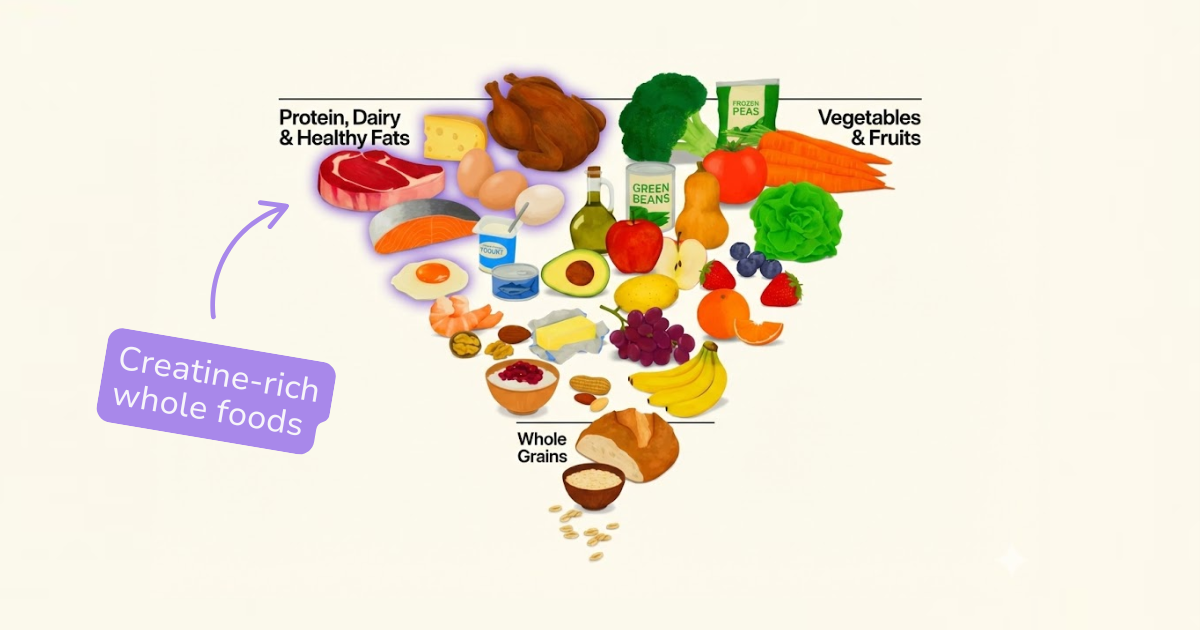
For decades, we’ve lived under the shadow of a triangle that told us the foundation of a healthy life was a mountain of bread, cereal, and pasta. It was a story that almost prioritised shelf-life over human life, and for millions of people, the results of that experiment are written in the rising rates of metabolic disease and cognitive decline. But the narrative is finally shifting. With the release of the new MAHA (Make America Healthy Again) dietary guidelines, the food pyramid hasn’t just been updated; it’s pretty much been completely inverted.
Is this a return to nutritional common sense? The message is simple: Eat real food. This is a basic, fundamental shift toward seeing human nutrition as a complex biological system that requires high-quality, nutrient-dense fuel to function. By ending the war on fats from whole food sources and placing a firm limitation on added sugars, the framework is finally acknowledging that our biology craves what is ancestral and unprocessed. Shocker.
To gather an expert opinion, I checked in with our Creatine Researcher, Felipe Ribeiro, and Global Health Advisor, Derek Yach.
They both agree that the most significant shift for creatine fans is the "Protein Priority." The new guidelines align with research from the last two decades, suggesting a target of 1.2 to 1.6 grams of protein per kilogram of body weight. This is finally about metabolic health, satiety, and the prevention of sarcopenia as we age. Derek made it clear that prioritising foods like high-creatine fish (such as herring and salmon), eggs, and other whole-food sources of protein like meat and cheese allows us to align our intake with our body’s actual requirements for maintenance and growth. A deliberate focus on fish also provides a great path to managing saturated fat intake and reducing the overall environmental impact of a protein-rich diet.
Furthermore, the 'Eat Real Food' philosophy, of course, naturally also places a renewed emphasis on fruits, vegetables, and plant-based foods as a vital part of a balanced diet. This is a crucial component for fibre, micronutrients, and overall metabolic health. However, this is also where a dietary challenge emerges. While a plant-rich diet is beneficial, it contains negligible amounts of creatine. This is an important consideration for those who adhere to plant-based diets, as the deficiency gap is often more pronounced, strengthening the case for viewing creatine as an essential supplemental nutrient.
Even with an increased emphasis on protein-rich foods, it is unlikely that our intake of certain vital molecules will reach sufficient levels through diet alone. Felipe even referenced data that shows that approximately 70% of older adults do not consume even one gram of dietary creatine a day. This is why we are beginning to view creatine as a "conditionally essential nutrient." While the new pyramid points us toward the right foods, the reality of the modern lifestyle often leaves us short of the levels needed for true neuroprotection and cellular energy.
“As a result, dietary creatine intake may be expected to increase, since the main dietary sources of creatine are meat and certain fish. However, it is unlikely that intake will reach sufficient amounts through diet alone.” Felipe Ribeiro
This is where the insights from our advisor, Derek, become so vital. Within this new framework, we shouldn't view creatine as just a "performance enhancer" for the weight room. Instead, it is a food-derived bioenergetic component that supports muscle function, physical resilience, and cognitive performance, especially under conditions of stress or ageing.
As Derek points out, creatine is synthesised naturally from amino acids and found in meat and fish, but its role in cellular energy metabolism in both muscle and brain tissue makes it super, super important for overall and functional health.
“Framed this way, creatine complements MAHA priorities by supporting metabolic health, preserving function across the life course, and promoting resilience rather than performance enhancement.” Derek Yach
We are incredibly excited about this shift. Are you? We are potentially witnessing the beginning of a time in which overall human vitality is prioritised by regulators. While the guidelines might not explicitly name every functional nutrient yet (baby steps, right?), they have built the perfect foundation for them.
What Felipe ultimately suggested was this: as research continues to advance, we may very well see molecules like creatine included in these official guidelines one day. So until then, we are here to provide the tools and the education to help you navigate this transition.
Common Questions About Creatine and the New Food Pyramid
What is the "New Food Pyramid"?
For a long time, the old food pyramid told us to eat a mountain of bread, cereal, and pasta. The new "Make America Healthy Again" (MAHA) guidelines have flipped that upside down. Now, the most important part of your diet (the foundation) is "Real Food" like meat, fish, eggs, and healthy fats.
What does "Protein Priority" mean?
This means that every meal should focus on high-quality protein first. The new goal is to eat 1.2 to 1.6 grams of protein for every kilogram you weigh. Eating this way helps your muscles stay strong as you grow older and keeps you feeling full so you don't snack on junk food.
Where does creatine fit into this new plan?
Creatine is a natural "energy helper" found in the foods at the bottom of the new pyramid, especially meat and fish. While the official rules don't list it by name yet, it is a vital part of the "Protein Priority" because it helps your cells work better.
Why is creatine important for my body?
Creatine isn't just for people at the gym; it is a "bioenergetic component" that acts like a battery for your cells. It helps with:
Keeping your body moving and resilient.
Helping your brain stay sharp, especially when you are stressed or getting older.
Protecting your body from getting weak as you age.
Can I get enough creatine just by eating "Real Food"?
It is actually quite hard to get enough! Even though we are eating more protein now, there is a "fascinating gap" between what we eat and what our bodies need. Research shows that 70% of older adults do not even get one gram of creatine a day from their food. Because of this, some experts call it a "conditionally essential nutrient," meaning your body might need more than you can get from a normal dinner.
Will creatine ever be an official part of the guidelines?
Right now, it is an "invisible foundation" for health. However, as scientists learn more, they believe that molecules like creatine might one day be officially added to the government’s healthy eating rules. For now, focusing on the "Plate Method” (filling your plate with high-quality protein and veggies) is the best way to start.
Beyond the gym, top research confirms that creatine is one of the safest and most effective supplements for longevity and healthy ageing across the lifespan, supporting both cognitive function and muscle strength. As millions of people using GLP-1 medications face muscle risks, creatine's role as a complementary nutrient alongside a healthy diet and activity could be decisive. For a deeper dive, be sure to check our Jenerise Creatine 101 Guide.
With any other creatine questions, don’t hesitate to email me! rachael@jenerise.com
We all rise together,
Rachael Jennings | Co-Founder + CBO, Jenerise