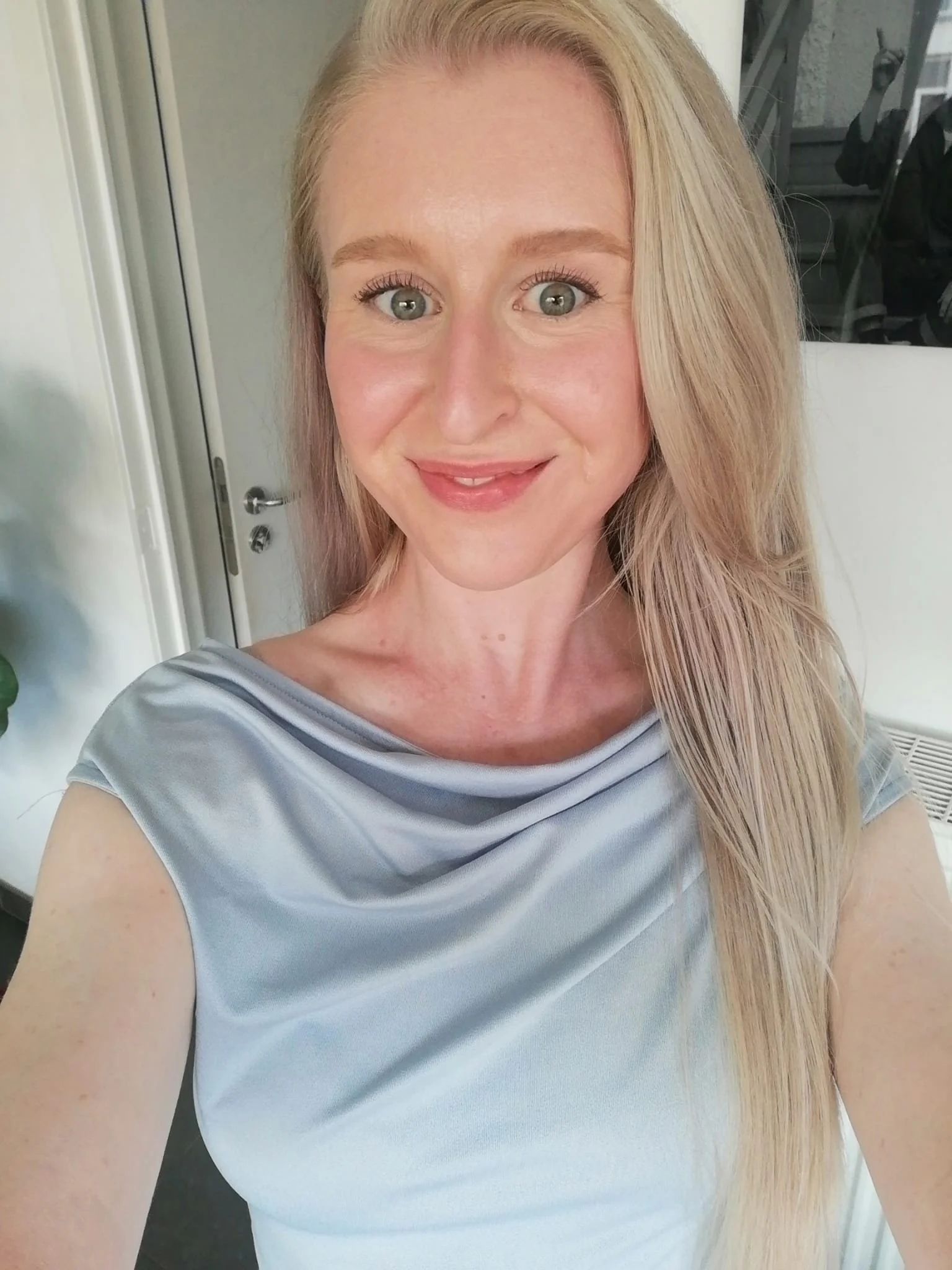
Seizing the Years with Louise Barnard
Some people follow a well-trodden path, mapping their lives according to expectations. Louise Barnard is not one of those people. From breaking into the exclusive world of advertising to embarking on a spontaneous podcasting road trip across the US, she’s made a habit of trusting her instincts—and rewriting the rules as she goes.
Now a mother of three and a fierce advocate for movement, energy, and longevity, Louise has built a life that works on her own terms. But it didn’t happen overnight. Her story is one of curiosity, reinvention, and a deep commitment to listening to what truly feels right.
I sat down with Louise to talk about her unconventional journey, the moment she decided to leave the corporate grind behind, and how she approaches energy, not just in fitness but in every aspect of life.
Realising She Needed To Be The Architect Of Her Own Life
Rachael Jennings: Before we dive into my questions, I’d love to get a bit of background. Who is Louise? I’ve been following you on LinkedIn, and your stories have taken me by surprise. Like the one about your US podcast road trip—I never saw that coming! You seem full of unexpected turns.
Louise Barnard: I guess my path has never really been linear. I’ve always followed my gut, staying open to new experiences and listening to what feels right. If something stops feeling right, I pivot.
I grew up going to a comprehensive school—not a particularly great one—and later studied at a polytechnic university. While I was there, I decided I wanted to break into advertising. But back then, the industry felt like an exclusive club, dominated by Oxbridge graduates and a bit of a boys' club. I knew I’d have to carve my own way in, so I immersed myself in reading, learning, and figuring out how to get through the door. Somehow, I landed a role in one of the top ten ad agencies and worked my way up fast.
Advertising was incredible in my twenties—fast-paced, creative, and full of fascinating people. But by the time I was approaching 30, newly married and thinking about starting a family, I had this realisation: this career, this way of living, wasn’t serving me anymore. I was spending too much time either in the office or in the pub. I wasn’t as healthy as I wanted to be. It just wasn’t working.
So, I did something drastic. I left.
I set off on a road trip across the US, blogging and podcasting along the way. That adventure changed everything. I fell pregnant while I was there and, soon after, started my own business—not just to work for myself but to create a life that actually worked for me.
That shift was about more than just work. I realised I function best when my life is fully integrated—work, movement, family, creativity. I don’t think in straight lines. If I need to go for a run in the middle of the day because that’s when my best ideas come, I do it. I don’t believe productivity has to mean being glued to a desk.
As I had children, that mindset became even more important. I wanted to be there for their assemblies, and their sports days. I wanted to build a life where I wasn’t forced to choose between career and presence. So I designed a way of working that allowed me to do both.
Balance Isn’t Perfect, It’s About Knowing What Fuels You
Rachael: That leads me to something else I wanted to ask. Living well looks so different for everyone—it shifts based on our priorities and goals. How do you define it for yourself now, and has that changed over the years?
Louise: I think it’s always evolving. Becoming a parent was a big shift for me. There’s this constant push and pull—you want to grow a business, to exercise, to be fully present for your children. But there’s only so much time, and you’re always figuring out how to make it all work.
I don’t think there’s ever a perfect balance. But for me, it’s about finding harmony—knowing what I need in order to feel good, to be present in all the areas of my life. Sleep, movement, time to myself—those things matter. I’m a better version of myself when I prioritise them.
I’ve learned that I think more creatively when I’m moving, especially outdoors. So I don’t sit at my desk forcing ideas—I go for a walk in nature and let them come to me. I also know I’m a better mum when I’ve exercised. Saturday mornings, my kids will ask, "Where are you going?" and I tell them, "I’m off to boot camp, I’ll be back in an hour—but you know I’ll be in a much better mood all day long!" And they get it.
So for me, living well isn’t about rigid schedules or perfect routines. It’s about understanding what fuels you, what makes you feel good, and giving yourself permission to build your life around that.
Noticing the Small Things Changed Everything
Rachael: I love what you’re saying about giving yourself permission—not waiting for someone else to say it’s okay to step away from your desk or take time for yourself. Has your mindset around this changed over time?
Louise: Absolutely. The big shift for me was moving from my 20s to my 30s, which was also when I became a parent and left the advertising world to start my own thing.
Before that, I was always just doing—full-on work, full-on play, constantly moving. But in my 30s, I started paying attention. Instead of just pushing through, I began noticing how things made me feel and how they affected the people around me.
Take barefoot shoes—I’ve worn them exclusively for the last five years, and my kids have never worn anything else. Before, I never questioned footwear—I just assumed sore feet and back pain were normal. But once I switched, I realised how much better I felt. The same happened with breathing. After reading Breath by James Nestor, I started nasal breathing and mouth taping at night. I used to think I just had a permanently blocked nose, but now I rarely get sick.
So, the shift for me has been moving from just doing to being mindful—listening to my body and making small changes that have a big impact.
Rachael: That’s fascinating. It’s incredible how something as simple as changing your shoes or how you breathe can make such a difference. And I love that you’ve passed that mindset onto your kids. So much of what we believe about health is just accepted as ‘normal’ when it doesn’t have to be.
Louise: Exactly. And it comes back to permission—allowing yourself to do things differently.
Some people don’t like barefoot shoes because of how they look, but I see ‘normal’ shoes and think, How do people wear those? The same applies to how I work. I don’t just sit at a desk all day. I move. I sit on the floor, stand, use a chair, go for walks. People are used to seeing me at odd angles on Zoom because my background is floor-level!
We weren’t designed to sit in one position for hours. The more we move, the better we feel, work, and show up for life.
Picturing Your 85-Year-Old Self
Louise: When you were talking, it reminded me of an exercise I did recently—one where you visualise your older self and ask, What advice would they give you now? As I wrote it out, I imagined meeting my 85-year-old self in the woods.
The woods are special to me; I love going for walks there. And in this visualisation, my older self thanked me for laying the foundations that allowed her to keep doing what she loved—walking in the woods, even at 85. That moment made me realise just how important it is to take care of my body now so I can continue doing the things that bring me joy in the future.
The terrain in the woods is uneven, muddy, and filled with tree roots. You don’t often see 85-, 90-, or 95-year-olds out for daily walks in those conditions. But my attitude is use it or lose it.
So, I walk in the woods every single day. I do the work now—wearing barefoot shoes, sitting on the floor while I work, strength training, focussing on stretching and mobility once a week, doing HIIT workouts—because I want to be able to move freely for as long as I live. I’m not going to let a lack of preparation today take that away from me in the future.
Pushing Limits at Hyrox
Rachael: Tell me about your recent Hyrox challenge, how was it?
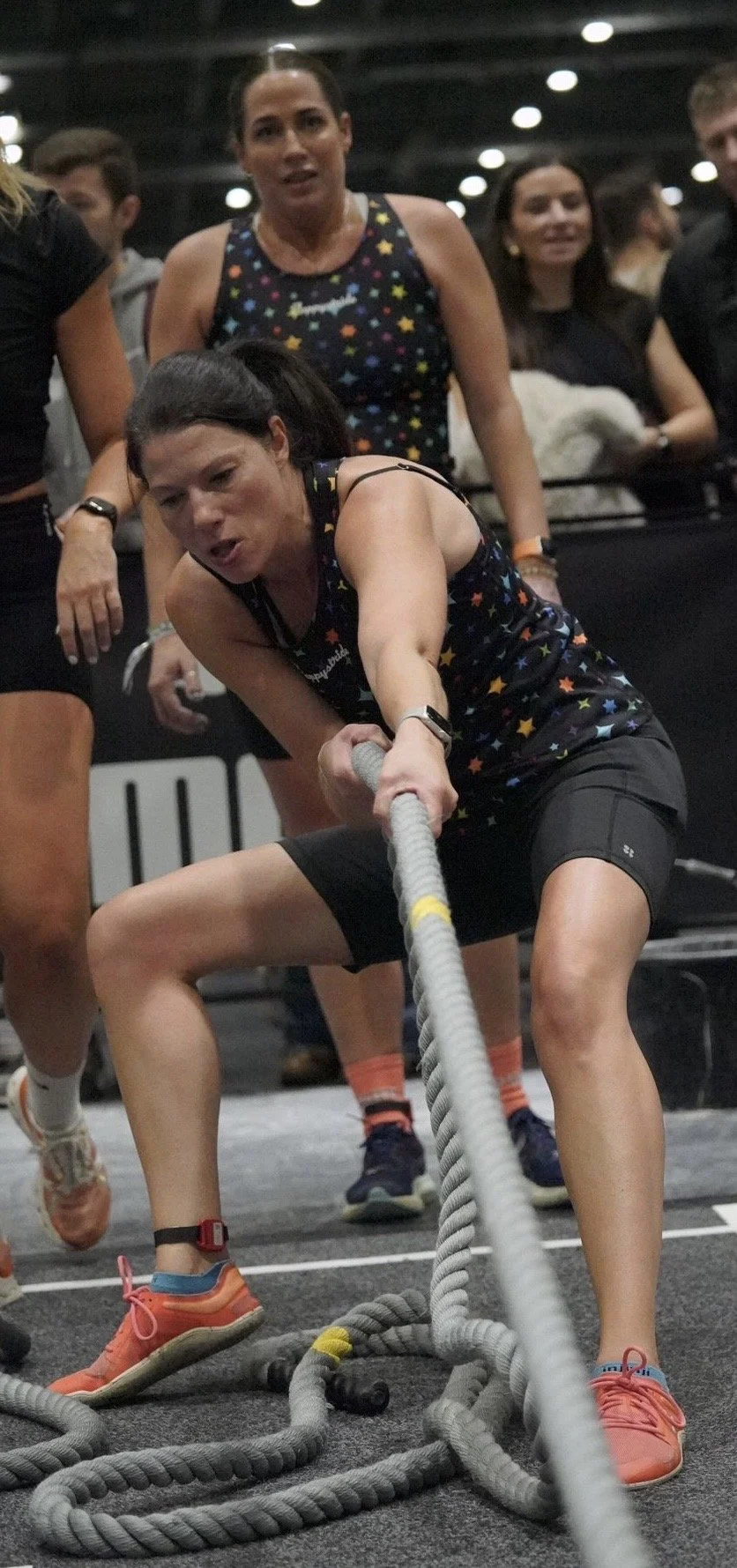
Louise: It was all very Instagram—live from Hyrox! And there we were, two women in our 40s, looking around and thinking, What are we doing here? Everyone else seemed younger, fitter, decked out in the latest gear. We didn’t exactly blend in. But once we got started, none of that mattered.
The race itself? Brutal. But in the best way. And the entire time, we kept saying, Next time… next time… Because, of course, we’re doing it again. That’s how it hooks you. It gets under your skin, and suddenly, you want to push harder, move faster, be better. That’s why it’s got this cult-like following.
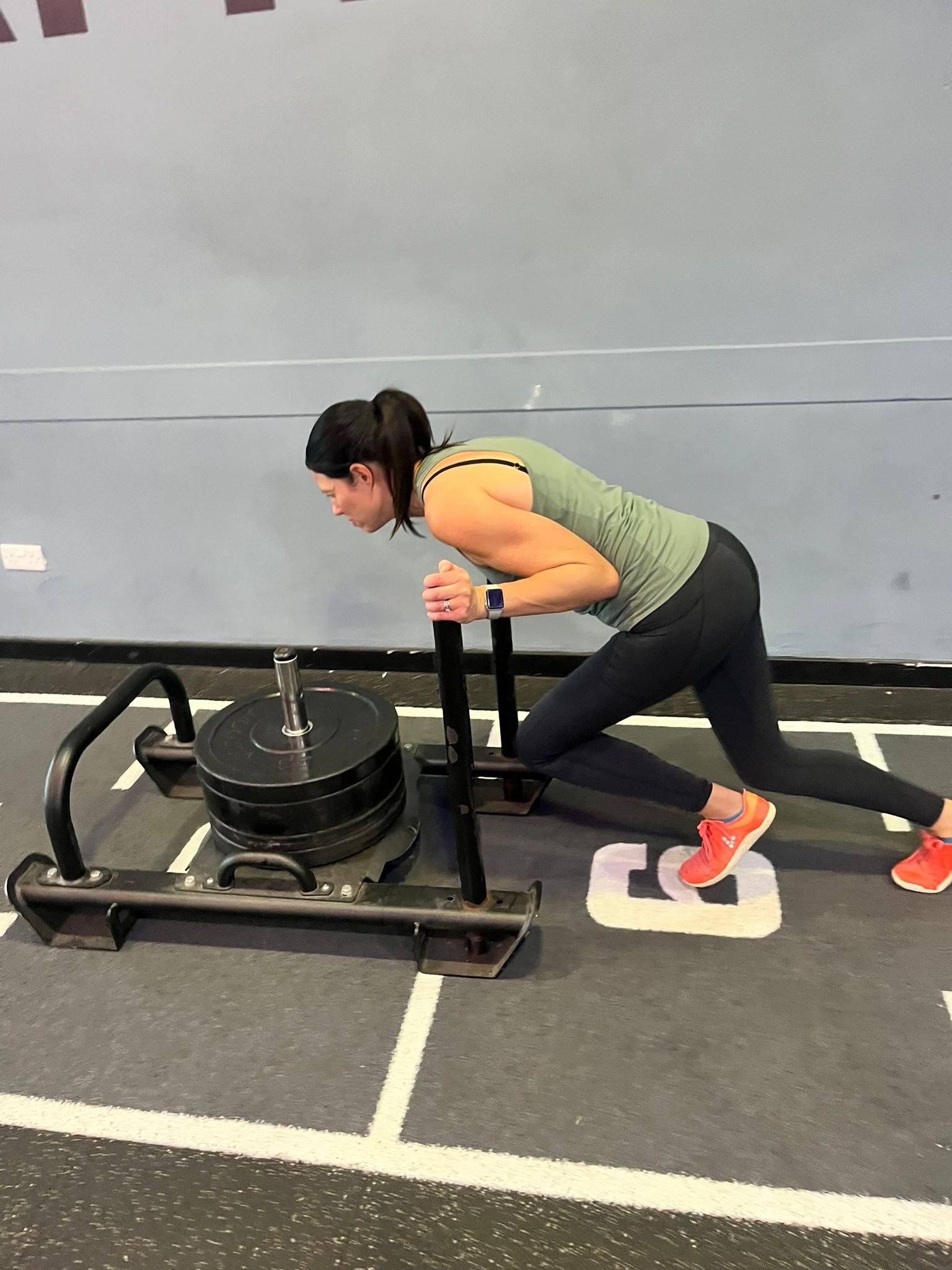
I was there in my barefoot shoes, surrounded by people in these high-tech running shoes with carbon plates. And I did get a few looks, but at this point, I don’t even care. I know what works for me. And honestly, it was such an experience because, like you said, it’s really intense. It’s eight stations mixed in with a total of 8 km of running, and the stations include things like a sled push, sled pull, rowing, burpees, and farmer’s carries.
So, I think what I loved about it is that it’s this real mix of endurance and strength, and I like both of those elements. I mean, I run, but I also do weight training. So, it felt like this great test of overall fitness. And because I was doing it with my friend, we could split everything between us, which made it feel a little more manageable. But still, it was brutal!
One of the hardest things for me was the sled push. I wasn’t used to pushing that kind of weight over that kind of distance. I don’t have that natural body weight to leverage, so I really had to dig in. But once we got through that, I actually found myself really enjoying it.
Rachael: That’s so cool. So, was there a point where you felt like, Okay, this is too much, I can’t do it? Or did you just power through?
Louise: I think the moment where I really had to mentally push myself was probably during the burpee broad jumps. By that point, my legs were just completely fried, and I could feel them screaming at me. But I just kept thinking, Just one more, just one more, and eventually, you get through it.
And the atmosphere was incredible. There was so much energy, it really does help when you feel like you're part of something bigger. And I think that's what made it so fun in the end. Because when I finished, I was exhausted, but I also had this huge rush of accomplishment.
The thing I found most fascinating was how strategic it was. It’s not just about being fit—it’s about knowing how to use your energy. Every station, every run, was a constant dialogue with myself: Do I go all out here? Hold back a little? Can I push harder? Should I slow this run so I can hit the next station stronger?
And because I was competing with a partner, it wasn’t just about me—it was about us. Reading each other’s strengths, spotting the moments when she looked tired and stepping up to take more of the load and vice versa. It was this constant, almost instinctive energy exchange, adjusting as we went.
Now that we’ve done it once, we’re obsessed with doing it better. We finished in about an hour and 31 minutes, which was pretty much our target. But now? Now, we know the game. And next time, we’re going in smarter, faster, and even more dialled in.
Rachael: Love that. Okay, last question—would you do it again?
Louise: Oh, 100%. I mean, I was sore for days afterwards, but I’d absolutely do it again. Maybe even the individual category next time. We’ll see!
The Art of Energy Management
Rachael: It sounds like the biggest challenge wasn’t just the physical side—it was managing energy. I’ve done marathons and half-marathons, and while pacing is a factor, you’re still just running the whole time. But Hyrox? That’s different. You’re shifting between high-intensity bursts and strategic pauses. Did that make you think differently about how you manage energy in your daily life?
Louise: Completely. It’s all about awareness—learning to read your own energy levels and knowing when to push when to hold back, and when to recharge. Because energy is exhaustible, but it’s also renewable.
There used to be this mindset of just pushing through—grinding on, no matter what. Now, I’m much more intentional. I’ve learned to respect the peaks and troughs. Some days, I wake up and feel unstoppable. On other days, I know I need to be kind to myself, slow down, and reset.
That’s why sleep is non-negotiable for me. I wake up early, but I go to bed early. If I don’t, I feel it instantly—I’m less mindful, less present, and everything feels harder. Managing energy isn’t just about getting through a race; it’s about getting through life in a way that feels good, sustainable, and strong.
I used to just bumble through the day, losing the plot a bit. When I didn't get enough sleep, everything felt chaotic. But if I got a good night’s sleep, I'd wake up feeling like, Okay, this is good. It completely changed how I managed my energy.
The other thing that made a massive difference? When I eat. Over the last few years, I’ve been experimenting—just seeing what works for me. I used to think I had to eat the minute I woke up. I’d be starving, so I’d make this huge bowl of porridge with loads of fruit. And at first, I’d feel brilliant.
Then, by 11 a.m.? Absolutely exhausted. Tired. Grumpy. Craving coffee. Starving again. And I just thought, Well, that’s me, I guess.
But then I started looking into eating windows and how timing affects energy. I switched things up—now I don’t eat until between 9 and 10. And instead of porridge, I have eggs, avocado, nuts—something with protein and healthy fats. And the difference is huge. No crashes. No mid-morning hunger. I can go all the way through till about 3 p.m., have my main meal then, and that’s it. I don’t wake up starving. I don’t run out of energy.
That old way of eating? It was all wrong for me. But that doesn’t mean my approach will work for everyone. It’s just about experimenting, paying attention, and adjusting. And I’m not rigid with it—weekends are more relaxed, we eat later, sometimes eat rubbish, and that’s fine. It’s about having a structure that works most of the time.
It also helps that I set up my own business. I don’t have to shovel breakfast down before racing to an office. I can eat at half nine, ten o’clock—whatever works. And I think that is the key. Just finding what actually works for you and making it fit into your life.
The Stories We Tell Ourselves
Louise: I was just thinking—so much of this comes down to the stories we tell ourselves and how we define ourselves. For years, I told myself, I’m not a runner. I’d go for a run, and it never felt easy. I’d look at other people—especially those who run marathons—and think, How do they do that? A marathon felt impossible.
But here’s the thing—I do run. I run once or twice a week, and I actually enjoy it. So why was I telling myself I wasn’t a runner? The truth is, I am a runner—just not in the way I imagined a runner should be. I’m not an elite athlete, but I love being out in the woods, moving my body, and if I don’t have time for an hour-long walk, I can cover the same ground in half the time if I run. So, I run.
We do this with so many things. People say I don’t like exercise. But what does that actually mean? Do you dislike all movement? Or do you just not like a certain type? Maybe you love being outside. Maybe you enjoy socialising. If that’s the case, find an activity that fits—join a boot camp, go for group hikes, or take a dance class. The key is to focus on what you do enjoy, rather than writing something off completely.
Rachael: Exactly. It’s about identifying what you actually enjoy about an experience. Take drinking, for example. If you ask people why they love going out, a lot of the time, it’s not actually about the alcohol—it’s about the socialising, the random conversations, the connection. If that’s what you love, you can find it elsewhere—maybe in a walking group, a coffee meet-up, or a workout class. You don’t have to give up what brings you joy; you just shift where you find it.
Louise: Yes! And with something like running, don’t focus on the act itself—focus on what it gives you. Maybe it’s time to listen to your favourite podcast. Maybe it’s a way to explore new places. Maybe it’s time with a friend or a parent. For me, running became my lifeline during COVID. I had a four-week-old baby, a two-year-old, a four-year-old, and I was running a business while my husband worked from home. It was chaos. But every day, I’d go for a run, and it was my one moment of peace. It wasn’t about fitness—it was about space.
If something makes you feel better, lean into it. Build habits around what actually serves you, rather than forcing yourself into a version of health that doesn’t feel natural.
Rachael: Yes, and I think that’s the challenge—recognising that every decision is a fork in the road. When you know what you need—whether it’s time alone, connection, or movement—you can ask yourself, Am I choosing the version that benefits future me? Life is just a series of those little decisions.
So, if someone feels intimidated by change—whether it's running, barefoot shoes, or anything else—what would you say?
Louise: Start small. If you’re curious about barefoot shoes, don’t jump straight into running in them. Maybe start with a pair of trainers that look cool but have a barefoot sole. Or try barefoot walking shoes first. When something feels overwhelming, it’s usually because we think we have to do everything at once. But just dip a toe in—see how it feels. If you like it, add a little more.
It’s like how I always take the stairs instead of the escalator. When I’m with people, they’ll say, Oh, you don’t like escalators? And I’ll reply, I don’t mind escalators—I just take the stairs. It’s a tiny shift, but it changes the way I see myself. I’m someone who takes the stairs.
Rachael: Exactly! Small, incremental changes. And paying attention to whether they actually make you feel better. So many of us try things because we think we should—whether it’s a certain diet, workout, or lifestyle habit—but if it doesn’t work for you, you don’t have to force it. The key is finding what actually fits.
Staying Open to Possibilities
As our conversation draws to a close, one thing becomes abundantly clear—Louise Barnard approaches life with an open heart, an open mind, and a willingness to embrace whatever comes her way.
"I don’t like to plan too far ahead or lock myself into anything too rigid," she shares. "For me, it’s about asking: How am I feeling right now? If something is working, great—I’ll lean into it. If it’s not, I’ll pivot and try something else."
That openness has led her to unexpected experiences, like competing in Hyrox—something she hadn't even heard of until a friend suggested it. "I just thought, Yeah, why not? And now, it’s a part of my life," she says. The same philosophy applies to challenges on the horizon—she doesn’t always know what’s next, but she trusts that when the right thing comes along, she’ll recognise it and say yes.
At the heart of it all is a long-term vision: making choices that ensure her future self—her 85-year-old self—can still embrace new experiences. "I don’t ever want to say, I wish I could do that, but I can’t, because my body won’t let me. The only reason I want to say I can’t is because I’m choosing to spend my time elsewhere—like with my kids."
And so, her goal remains simple yet profound: to stay well, to stay strong, and to stay open. Because when you approach life with curiosity and a willingness to say yes, you never know where it might take you.
Thank you so much, Louise, for sharing your story with us!
If you would like to be featured or know someone who would be great to feature, please don’t hesitate to email rachael@jenerise.com 😊
Seize the years,
Rachael Jennings | Co-Founder + CBO, Jenerise