When we launched Jenerise Cr.01™ in May, we made a decision that felt small at the time. Every batch we make would be published, with its lab results, on a page anyone could open on their phone. We called it the Transparency Hub, and we built it in-house with Squidler, our partner for building Jenerise's in-house tools and platforms.
The reason is simple. The people who supplement with creatine every day want to know what is in it, and they want to check for themselves.
What does a customer see when they scan the QR?
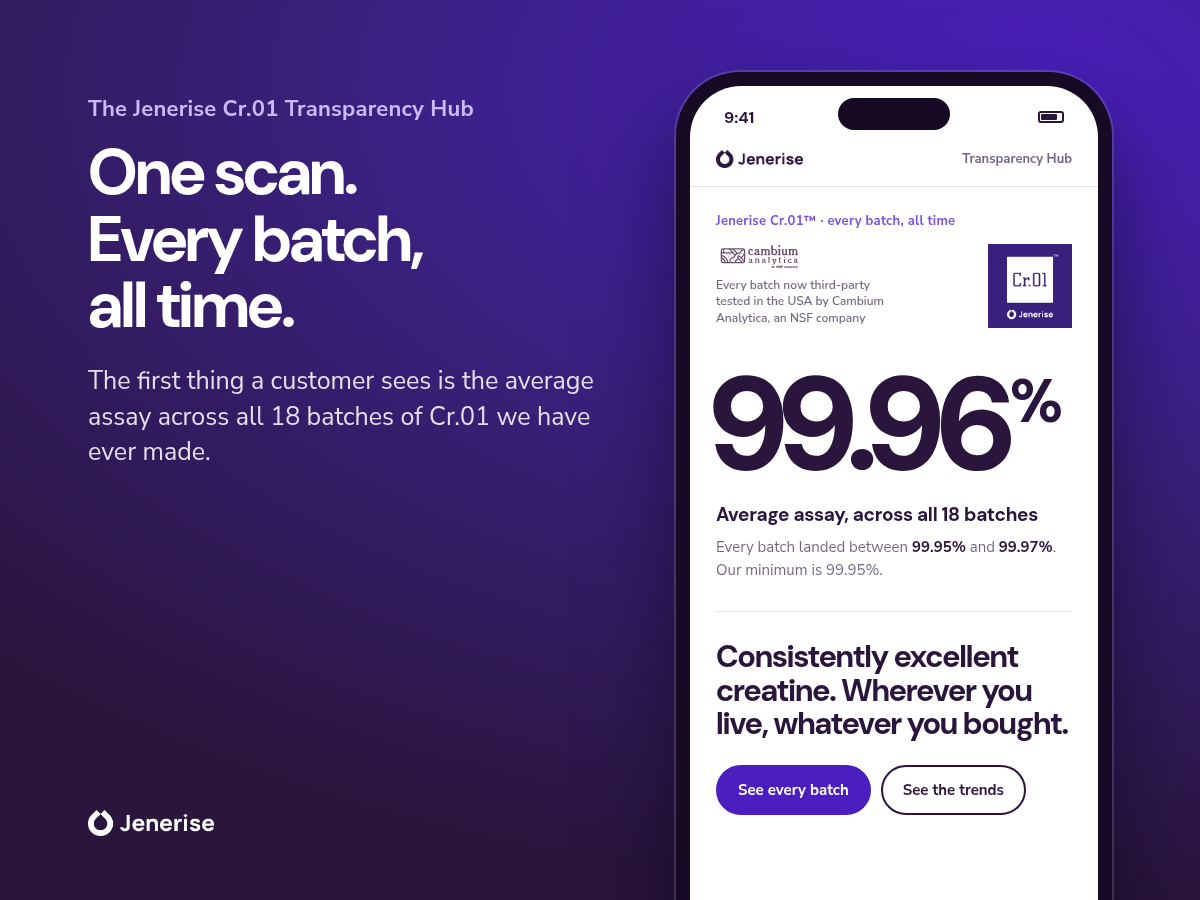
The QR code beside the Cr.01 seal opens the Hub in the phone's browser. There's nothing to download and nothing to sign up for. Here's what is there, screen by screen.
The headline number. The first screen shows the average content assay across every batch we have ever made, and the range those batches landed in, against our 99.95% minimum.
Every batch, ever. A timeline of every production batch, newest first, with each one's date and assay. The small-batch and sample runs from around launch are published too.
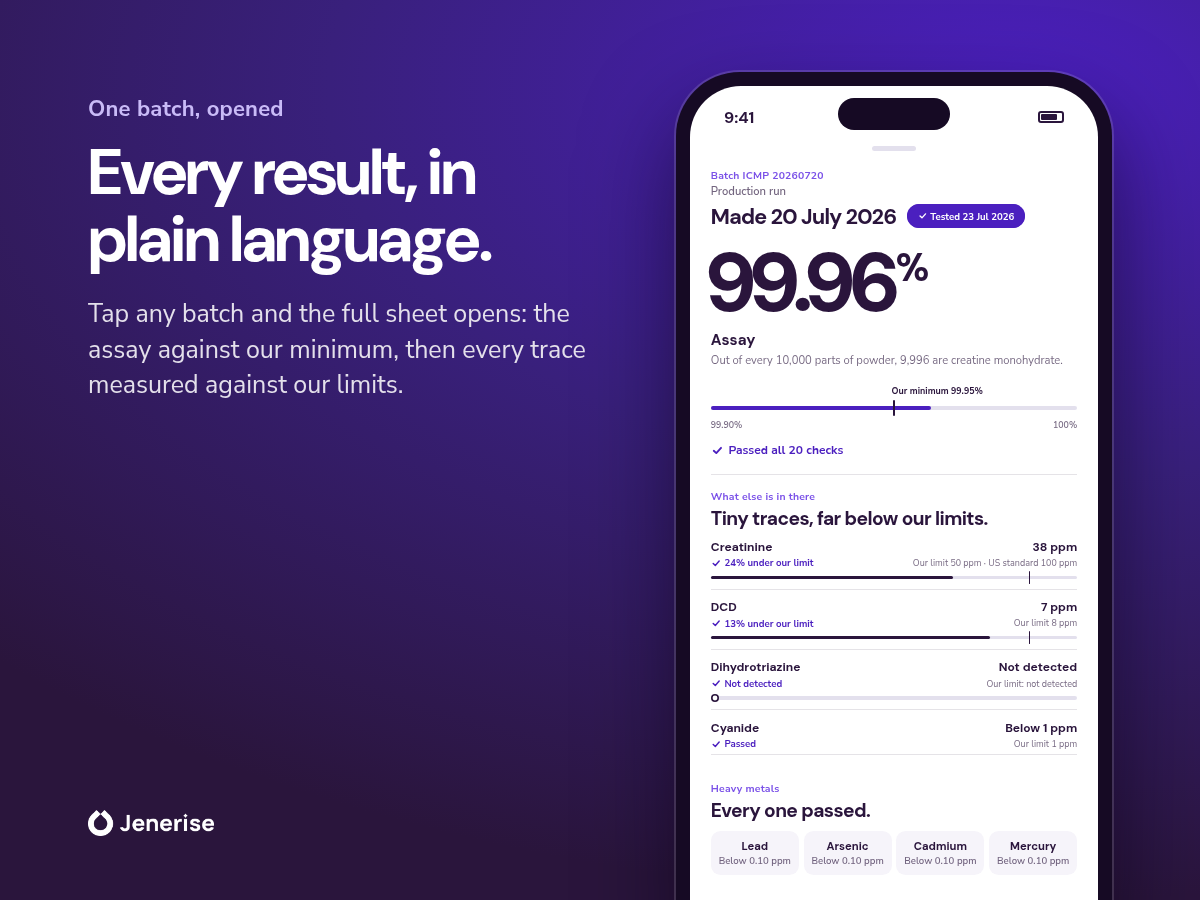
One batch, in full. Tap a batch and its results open in plain English: assay, creatinine, DCD and dihydrotriazine against our limits, heavy metals, microbiology and the physical checks. Each one has a short explainer of what it is and why it matters.
Independent testing, in progress. Each batch shows where it stands with Cambium Analytica, an NSF company and independent lab in the USA: sent, received, being tested, results published. Those results will sit next to ours as they come in, and anyone can ask to be emailed when they do.
Trends. A chart for each result shows every batch against our limit, so you can see consistency over time at a glance.
Where you live. Pick a region to see which batches arrived there and the brands using them.
What each certification means. Every certification and standard behind the batches, each with a plain-English explanation and its source.
Why do consumers want to see this?
The questions in our inbox have changed. Now the same few questions come up in almost every first conversation, and they are the questions their own customers are asking.
"Can I see the actual results?" People want measured values for real batches. On the Hub every batch shows its numbers.
"What about heavy metals?" For anyone who supplements with creatine every day, this is the question that matters most. Our limits for lead, arsenic, cadmium and mercury are up to 10 times stricter than the US standard, and every batch has passed. The Hub shows what that means in grams. Even in the worst case, at our lead limit, you would need about 88 g of Cr.01 a day, roughly 18 servings, to reach the FDA's daily reference level for lead.
"Who checks it, apart from you?" Independent testing in the USA is underway, and every batch now goes to the lab. Heavy metals are tested monthly by an independent lab. The certifications behind the batches are listed and explained on the same page.
"How do I know it's the same creatine every time?" The trends answer that. Every batch sits in a narrow band, and every batch meets the same limits, wherever it ships.
"Where does it come from?" Cr.01 is made in a creatine-focused facility, and the certifications behind it are on the Hub for anyone to read.
What does it mean for brands?
Your customer reads your label in the aisle, or at home with the tub in one hand and their phone in the other. That is when trust is won or lost. A scan that opens real results, in plain English, answers the question at the moment it's asked.
It also changes your own conversations. When someone in your comments asks how good the creatine is, the answer is already published, with dates. Your team can simply send the link. And as each batch's independent results land, your customers see them without you lifting a finger.
The Hub also ends at the Brand Partner Library, where people can find the brands that make their products with Cr.01. Transparency is the start of the journey to your product.
Built for brands who want to show their work
If your customers are the kind who check, see every batch on the Transparency Hub and then talk to us.
Rachael Jennings, Co-Founder & Chief Brand Officer, Jenerise
FAQs
What is creatine traceability?
Creatine traceability means being able to see where a batch of creatine came from and how it tested. For Jenerise Cr.01™, every production batch is published on the Transparency Hub with its date, its results and its independent testing status. Anyone can open it from the QR code on pack.
How do I verify creatine quality?
Look for measured results from real batches: content assay, impurities such as creatinine, DCD and dihydrotriazine in ppm, heavy metals and microbiology. Then look for independent testing alongside the manufacturer's own. The Jenerise Cr.01™ Transparency Hub shows all of these for every batch.
Is Jenerise Cr.01™ third-party tested?
Every batch now goes to Cambium Analytica, an NSF company and independent lab in the USA, and its results will be published on the Transparency Hub next to ours as they come in. Heavy metals are tested monthly by an independent lab. The Hub shows where each batch stands.
Is there heavy metal testing on creatine?
There should be, and it's worth asking any supplier for the results. Jenerise Cr.01™'s limits for lead, arsenic, cadmium and mercury are 0.10 ppm each, up to 10 times stricter than the US standard, and every batch has passed. The results for each batch are on the Transparency Hub.
Can my customers check which batch is in their product?
The Hub shows every batch we have ever made, so customers can browse all of them. Every batch meets the same limits, so the creatine in their product is held to the same standard as every other batch on the page.