Creatine and the Menopause Transition Webinar Recap
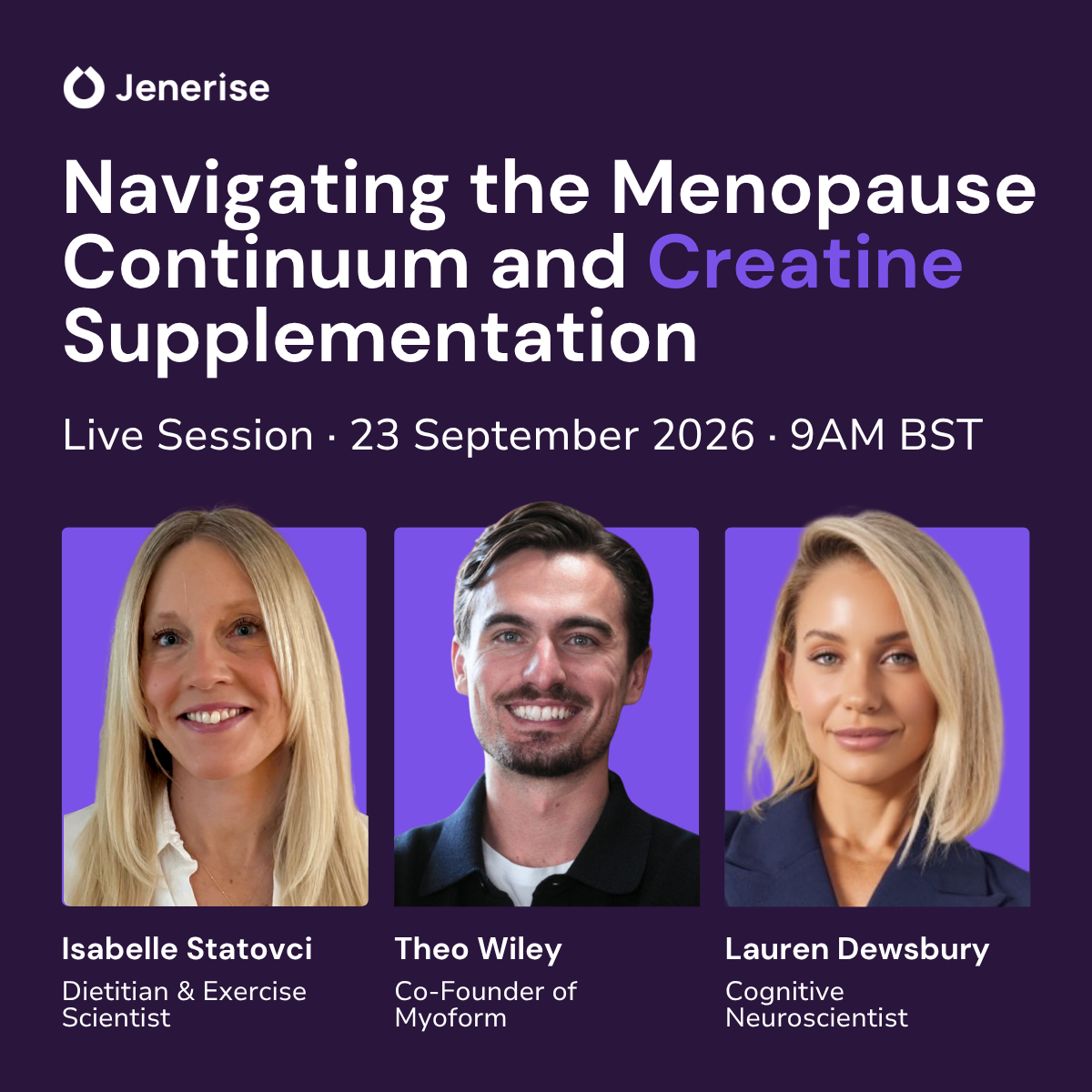
Recap of Jenerise's fourth quarterly creatine education webinar, with Isabelle Statovci, Theo Wiley and Lauren Dewsbury.
Creatine for women's health has had a loud year on social media. Most women meeting creatine for the first time are doing it through podcast clips, influencer posts and word of mouth, and they arrive with questions those formats can't answer.
Our September webinar, hosted by Jenerise Chief Brand Officer Rachael Jennings, asked three specialists to separate what the evidence supports from what is still hype. Isabelle Statovci covered the clinical research in perimenopause and postmenopause. Theo Wiley explained why individual responses to creatine differ. Lauren Dewsbury took us behind the scenes of a live clinical trial.
Key takeaways
Strength: the evidence is strongest here, but only when creatine is paired with resistance training.
Bone density: no trial has shown an improvement so far. There are early signals for bone strength, and trials may have tested the wrong window.
Brain, mood and sleep: promising, biologically plausible, and still early and inconclusive.
Safety: consistently strong across the trial data reviewed, with no serious adverse events reported.
Individual response varies: research suggests a meaningful minority of people see little rise in muscle creatine.
Perimenopause is the biggest research gap. Most trials were run after the transition.

Isabelle Statovci: What the research says (and doesn't)
Isabelle is an accredited practising dietitian and clinical and exercise scientist with a pharmaceutical background. She began by defining terms, because research often blurs them:
Perimenopause is the transition itself. Cycles and hormones become unpredictable; it often starts in the 40s, and it typically lasts 4 to 8 years (average around 4).
Menopause is a single point in time, confirmed only in hindsight, 12 months after the last period.
Postmenopause is everything after that.
She also separated changes clearly tied to the transition from those that overlap with ageing. Bone loss accelerates around the final period, pointing to a distinct hormonal transition rather than just ageing. Memory and processing speed dip temporarily in perimenopause and recover afterwards, a reversible, phase-specific pattern. Muscle loss starts in our 30s, with possibly some extra loss tied to the transition, but there is no consensus. Sleep and mood changes are partly hormonal and partly just midlife.
The case for creatine
Isabelle framed creatine as a quick-recharge battery for high-energy tissues, including muscle, bone and brain. She gave three reasons it may matter in this life stage:
Women generally make less creatine than men and take in less through diet, so there may be a shortfall before the transition begins.
Estrogen plays a role in cellular energy (ATP) production, and creatine supports the same pathway.
There is real evidence of benefit, at least for muscle, alongside a strong safety record.
Strength and muscle: the strongest evidence
A systematic review and meta-analysis of seven randomised controlled trials found an average 7.5 kg gain in leg press strength and roughly 0.37 kg of lean mass gain. The trials averaged about 24 weeks, so this is not an overnight effect. The catch is that creatine was always paired with resistance training. Isabelle addressed a recent study showing gains without training and urged caution. It wasn't conducted in this population, and the exercise groups were self-selected rather than randomised. Her view was that it shouldn't be read as a free pass to skip the gym. Most of the data comes from older and postmenopausal women, but one smaller perimenopausal trial showed the same pattern.
Bone: not shown yet, but a plausible timing problem
No trial to date, including a two-year study combining creatine with resistance training, has shown improvements in hip or spine bone mineral density. Isabelle's key observation was about timing. Every trial was run in postmenopause, and may have missed the roughly three-year window around the final period, when most bone loss occurs.
There was also an interesting secondary finding. In that same two-year trial, creatine helped the hip bone better resist bending and crushing forces even though density didn't change. An earlier trial found less shrinking of bone width. The proposed mechanism is that more muscle means more force on the bone, and bone strengthens under load. As Isabelle stressed, this is not yet proof of fracture prevention. Her framing: "not shown" is not the same as "doesn't work."
Brain, mood and sleep: early and inconclusive
Isabelle was careful here.
Cognition: one study showed faster reaction times and more brain creatine, but it pooled perimenopausal and postmenopausal women, so it can't speak to individual stages. A very small study that separated the groups found no significant cognitive change.
Mood: the CONCRET-MENOPA trial found fewer mood swings with creatine hydrochloride, but the result missed statistical significance. No other trial has tested mood directly in this population.
Sleep: one study reported improvement only in a perimenopausal subgroup, without a placebo control. CONCRET-MENOPA, which tested insomnia in a placebo-controlled design, found no significant change.
Her conclusion was that none of these threads yet support a claim that creatine improves brain function, mood or sleep.
Safety
Safety was the one area where nobody disagreed. Every trial to date, including long-term data, reported no deaths or serious adverse events and no meaningful increase in side effects versus placebo. That is backed by several large reviews, including in women. The one caveat is that future studies should record menopausal stage, so researchers can tell whether effects such as water retention or GI upset are specific to this population.
Dosing: context, not advice
Isabelle stressed that these figures show what trials have used and are not individual recommendations.
Strength and bone trials mostly used 3 to 5 g/day over months or years, with the strongest effects clustering around 5 g/day or more alongside resistance training. Lower-dose studies (3 g/day in one bone trial, 1 g/day in another) found no bone benefit, though whether dose explains that is unclear.
CONCRET-MENOPA tested different compounds at much lower doses (creatine hydrochloride at 750 or 1,500 mg/day, or combined with creatine ethyl ester). The headline brain and reaction-time findings came specifically from the 1,500 mg hydrochloride-only arm.
The wider creatine literature describes a loading phase of 20 g/day (4 × 5 g) for 5 to 7 days, or skipping loading and taking 3 to 5 g/day for 3 to 4 weeks to reach similar saturation, then 3 to 5 g/day ongoing. Brain-focused protocols elsewhere use 15 to 20 g/day short-term, then 5 to 10 g/day for maintenance.
The research gaps
Perimenopause has historically been treated as baseline statistical noise and not as a distinct physiological window. Isabelle's open questions:
Does starting creatine during the transition buffer against decline before symptoms emerge?
What are the right doses for cognition, sleep and mood?
Are postmenopausal bone benefits due to creatine itself or simply to more consistent training?
Is there a real mechanism for creatine in bone health?

Theo Wiley: Why some people respond and others don't
Theo is co-founder and CEO of Myoform, a precision nutrition company built on whole genome sequencing, blood biomarkers and lifestyle and biometric data. He opened with the idea that personalisation is a scale, not an all-or-nothing concept.
The personalisation pyramid
From easiest to most precise: age and sex (including life stage), goals and lifestyle, wearables and biometrics, health status through blood tests, and genetics at the base. Lower layers take more time and cost to collect, but they are not automatically more important. Age and sex tell you things genetics can't. Theo noted that menopause stage is hard to capture because there is no clear biomarker for it.
Same protocol, very different outcomes
Theo highlighted a 2024 dose-response meta-analysis (Pashayee-Khamene and colleagues) plotting fat-free mass changes against creatine dose. The scatter is wide: people on the same protocol show very different results. His point was that guidelines are built for the "typical" person and can leave many people underserved. Creatine also has no official RDA, as it isn't classed as an essential nutrient, so dosing advice tends to be flat (3 to 5 g, sometimes with a loading phase).
The genetics of creatine metabolism
Theo said research suggests roughly 20 to 30% of people show little to no rise in muscle creatine when supplementing. He was candid that those studies were small and the numbers should be taken "with a pinch of salt." He then walked through where genetics can influence the chain:
Kidney: the GATM enzyme combines glycine and arginine into guanidinoacetate.
Liver: the GAMT enzyme adds a methyl group to make creatine. This is demanding, using about 40% of the body's endogenously produced methyl groups, which is where variation in MTHFR could matter.
Transport: creatine enters muscle and brain via a transporter gene located on the X chromosome, so effects may differ between men and women.
Inside the cell: creatine is stored as phosphocreatine for fast energy.
To make this practical, Myoform combines many small variants into polygenic risk scores, used as a proxy for how efficiently someone may metabolise creatine. Theo also predicted that clinical research combining nutrition and genetics will more than double by 2030, particularly with AI.

Lauren Dewsbury: Inside the MENOCOG trial
Lauren is a cognitive neuroscientist and PhD researcher at Western Sydney University, and this trial is part of her thesis. She took the audience through the decisions behind designing a study when the literature is still in its infancy.
Who is being studied?
Postmenopausal women aged 45 to 65, recruited across Australia
Subjective cognitive decline: they notice changes in memory and thinking but still test normally on clinical cognitive tests
Elevated dementia-risk characteristics: a first-degree family history of dementia plus at least one cardiometabolic risk factor (high blood pressure, high cholesterol, BMI over 30, or a sedentary or insufficiently active lifestyle)
APOE4 status is tested
Current or recent menopause hormone therapy users are excluded, because systemic hormones could confound the outcomes
Lauren was clear that this is not a dementia-prevention trial.
Designed with women, run online
Before designing the study, the team ran focus groups. Women described short-term memory problems, word-finding difficulty, attention and focus issues, cognitive fatigue, lower stress resilience and mood changes. The barriers to trial participation were cost, time, caring responsibilities and overwhelm. The response was a fully decentralized trial with online assessments that participants complete when it suits them.
Trial structure
MENOCOG is a Phase 1 feasibility pilot enrolling 86 women. The participant journey runs from an online expression of interest and eligibility survey to a screening call, a local pathology blood test and baseline assessments. Participants are then randomised 50/50 to creatine or placebo, with the treatment kit mailed to them, for a 12-week intervention. Online assessments happen at baseline, weeks 4, 8 and 12, plus a final round four weeks after stopping to check for residual effects. Lauren noted that decentralisation makes participation easier but makes the trial more operationally complex, since engagement, communication and adherence are all managed remotely.
Recruitment: interest is not eligibility
The response was extraordinary. About 1,100 pre-screening surveys were completed, and social media drove the largest share (733). Only about 9% met the initial eligibility criteria. The top reason for exclusion was insufficient dementia-risk factors (682 cases), followed by current or recent hormone therapy use (355) and not meeting cognitive screening criteria (154). Participants could meet more than one exclusion criterion. Lauren's summary: high public interest did not translate into a readily recruitable trial population.
What is being measured
Brain fog is a subjective experience, not a single cognitive construct, so MENOCOG measures it from several angles:
Cognition: memory, attention, executive function and processing speed
Mood: the DASS scale (depression, anxiety, stress)
Downstream outcomes: sleep quality, emotional regulation and menopause-related quality of life
Biology: APOE4 status (to see whether carriers respond differently), systemic inflammation and lipid panels
The dose decision
There is no established optimal creatine dose for cognition. Lauren's team chose 10 g/day, split into 5 g in the morning and 5 g in the evening, and was explicit that this is a protocol decision, not an established cognitive dose. The rationale is that muscle benefits are seen at 3 to 5 g, but brain uptake across the blood-brain barrier is limited and transporters can saturate. Splitting the dose aims to saturate them twice and may also reduce potential GI side effects. Her slide summed up the uncertainty: muscle evidence isn't brain evidence, general populations aren't postmenopausal women, and short-term studies aren't 12-week chronic supplementation.
Why a feasibility study matters
MENOCOG is asking whether these women can be found and recruited, whether the criteria work in the real world, whether a remote trial can run well, whether women can adhere to 10 g/day for 12 weeks, whether the assessments are feasible, and whether participants will stay. Lauren's line: the first study doesn't need to answer every question; it needs to make the next study better.
What this means for brands
For brand and industry partners, the session pointed to a few practical conclusions:
Lead with the strongest evidence. Strength and muscle, alongside resistance training, is where the data is most robust.
Be careful with bone, brain, mood and sleep. The evidence is early, mixed or stage-pooled, so consider the language you use and check it with your regulatory advisers.
Be precise about life stage. Perimenopause, menopause and postmenopause are different, and most trials haven't separated them.
Present doses as trial context. Doses used in trials aren't personalised recommendations.
Plan for variable response and long timelines. Effects took around 24 weeks in strength trials, and some people respond less.
Design for adherence. Flavour, format, stability and ease of use decide whether consumers stay long enough to benefit.
Watch and keep learning
The webinar recording is available here: Rewatch on YouTube. Our next session in December features Jed Pratt from the University of Manchester, going deep on creatine and the brain. Subscribe to our newsletter to be notified when registration opens.
This post is educational and does not constitute medical advice.
We all rise together,
Rachael Jennings | Co-Founder + CBO, Jenerise
Worth knowing: Jenerise makes Jenerise Cr.01™, a third-party verified, precision-grade B2B creatine ingredient. This content is educational and entertaining but also drives awareness of our product.