Seizing the Years with Donald Hooton
There's a question Donald Hooton asked early in our conversation that I haven't been able to stop thinking about since.
"Think back to a moment when an adult or an influencer in your life suggested you change your physical appearance. You might not remember exactly what they said. But I promise you, you'll never forget how they made you feel."
I sat with that for a long time after we finished recording. Because he's right. Most of us carry those moments. And for some young people, those moments become the beginning of something dangerous.
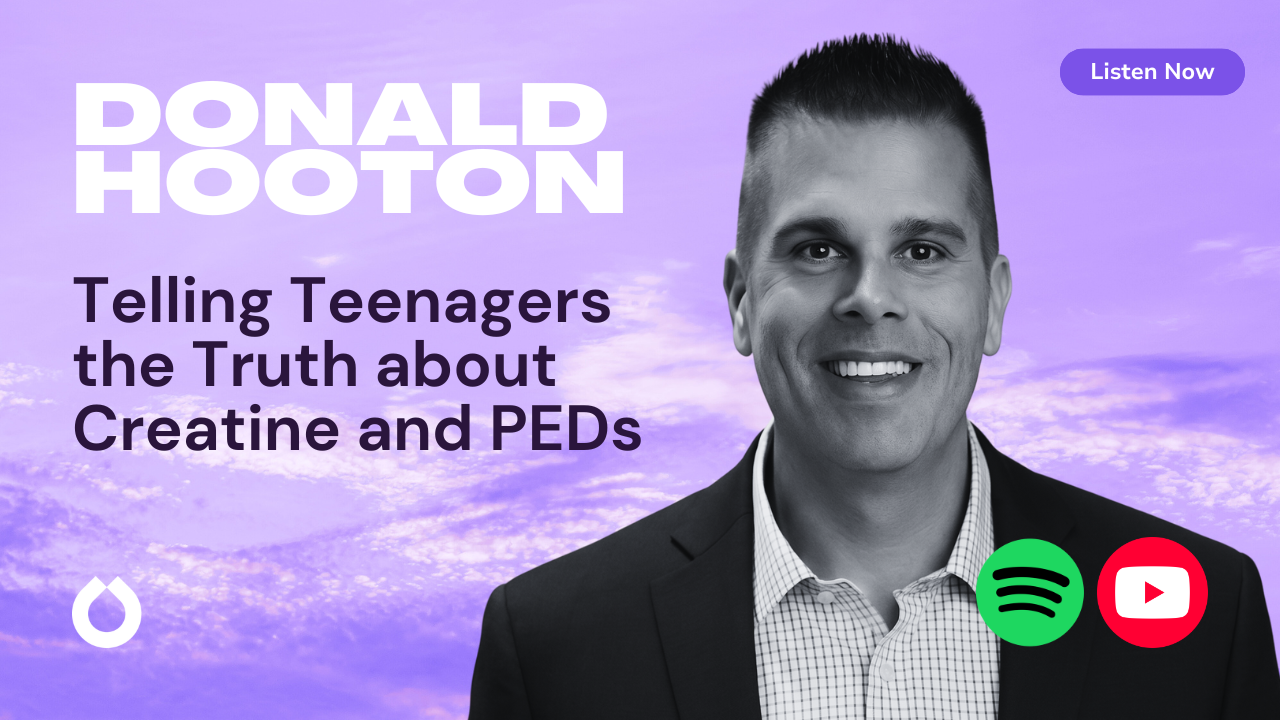
Donald is the president of the Taylor Hooton Foundation, an organisation his father started after losing his younger brother, Taylor, to the very specific and devastating chain of events that can follow anabolic steroid use. Taylor was 16, a talented high school athlete, and he started using injectables because half of his teammates were already using them, and he wanted to make the varsity starting lineup. He put on 30 pounds of muscle. He looked great to everyone around him. Nobody thought to question it.
Then came the erratic behaviour. The severe acne. The mood swings. A physician told him to quit cold turkey. He did. His body, which had stopped producing natural testosterone while the exogenous steroids were doing the job, couldn't recover quickly enough. Low testosterone can lead to depression. Taylor's depression was serious enough that he took his own life.
Donald and I spoke for over an hour, and what struck me most was how much of this conversation still felt urgent, still felt unresolved, not because people aren't paying attention, but because the landscape keeps shifting faster than our education can keep up with it.
The problem isn't the same as it was in 2003. It's bigger.
When the Taylor Hooton Foundation was founded in the early 2000s, the conversation was largely about anabolic steroids. Then dietary supplements entered the picture. Then, in just the past six years, you can't open social media without being served content about peptides, hormone replacement therapy, SARMS, and testosterone replacement therapy. Some of these things are legitimately therapeutic. Some haven't been approved for use in humans yet. And a lot of young people can't tell the difference, because no one is teaching them how to.
What's also changed is the psychology of the needle itself. Donald and I talked about this at length. In 2026, injecting yourself with something doesn't carry the same alarm bells it once did. Botox is normal. GLP-1s are mainstream. IVF is everywhere. TRT is increasingly common among men in their 40s, and the ads are on television. So when a teenager watches their dad's TRT delivery arrive in the post and also sees an influencer on YouTube casually discussing their "cycle," the psychological jump to "I'll just buy something online and try it" feels, to that teenager, like a very small step. Not the same thing at all, of course. But from where they're standing? It looks like it could be.
The creatine conversation is still happening, and it matters more than ever.
One of the reasons I was so excited to have Donald on is that his foundation's mission and ours overlap. The Hooton Foundation spends a lot of time answering questions from young athletes about creatine, specifically "Is it safe?" and "Isn't it basically steroids?"
Donald described this with a kind of tired affection I recognised immediately. You hear the same question for the twentieth time, but you also understand exactly why they're asking it. It comes from the bodybuilding culture of the 80s and 90s, when creatine and anabolic steroids somehow ended up in the same mental category, and the stigma stuck. Despite more than 680 studies. Despite 30 years of consistent, safe use across populations.
Creatine is something your body already produces. It's found in meat and fish. It supports muscle recovery and brain function. It is about as far from an anabolic steroid as vitamins are from heroin. And yet here we are, still having the same conversation.
What I've been reflecting on since our recording is how much the algorithm isn't helping. I mentioned to Donald that when I'm scrolling our Jenerise Instagram account, it takes approximately four minutes before the page shifts from people scooping creatine into water to people injecting unspecified things into their arms with zero captions. No context, no education, just "pounded it today." Even the algorithm is confused. And if the algorithm is confused, imagine what a 15-year-old with no prior knowledge is supposed to make of it.
Energy drinks deserve their own chapter.
I went off-script here, and I'm glad I did. The Hooton Foundation now includes energy drinks as a core part of their educational content, and Donald explained why with the kind of calm clarity that makes you want to share the clip immediately.
The original Red Bull had minimal caffeine in a small can. Today's energy drinks are frequently 200mg of caffeine per serving in 24-ounce cans, sold at eye level at every checkout counter, designed to look like candy. The American Medical Association recommends no more than 100mg of caffeine for anyone under 18. And caffeine is only part of the equation. Taurine amplifies the cardiovascular effect of caffeine. So does guarana. Nobody reads the label for those.
Donald told me about asking a group of students to raise their hands if they knew someone who drank three to five energy drinks a day. He estimated about 25% of hands went up every time. A girl walked up to him at the start of this year and told him she drinks five a day. Five.
At Jenerise, we draw a firm line between stimulant-based energy and what creatine actually does. Creatine is a foundational, non-stimulant support. It doesn't give you a buzz in 30 minutes. It doesn't jack your cardiovascular system. It works quietly, at the cellular level, over time. And in a world where we're all so conditioned to expect that immediate "felt it" feeling, creatine's subtlety makes it hard to market and hard for people to understand whether it's working. We talked about this too, and it's something I think about a lot in the context of energy drink culture. We're creating a generation of chronic fatigue through over-stimulation, and then wondering why nobody has energy. The irony would be funny if it weren't so serious.
On influencers who are honest about drug use.
I asked Donald about someone like Dr Mike Israetel, who openly discusses his PED use in the spirit of transparency, to counter the false expectations that come from looking at drug-built bodies and assuming they're natural. It's a pretty complicated question.
Donald's answer was thoughtful and honest. He has real respect for the information and thinks the transparency matters. For an adult who can receive the full context, understand the risks, and has access to a doctor who can monitor medically supervised use, that kind of honesty is valuable. The problem is that YouTube has no age gate. A 14-year-old watching that channel hears "this is the only way to get this physique" and immediately tunes out the part about heart damage, shortened lifespan, and the fact that legal TRT prescribed by a doctor is very different from black market drugs bought on Reddit.
Because teenagers don't think about 10 years from now. That's not a character flaw. That's neuroscience. Their brains aren't there yet. And the adults who are supposed to be the guardrails are often completely unaware of what their kids are consuming. Donald told me about a professional strength and conditioning coach in Major League Baseball, someone whose entire career has been built around elite athletic performance and performance-enhancing substances. Donald suggested he look up a few of the content creators his kids were watching. The coach texted back that Saturday afternoon: "Holy s***."
If that person is blindsided, the average parent doesn't stand a chance without some help.
So what do you actually do if you're worried about someone?
This was where Donald was at his best, I think, because his advice is simple and the opposite of what most adults instinctively want to do.
Don't lecture. Don't say "don't do that." That's the fastest way to close the door.
Instead, educate yourself first. The Hooton Foundation has a whole section of its website with questions specifically designed to help parents and coaches open the conversation. And the goal isn't to demonise drugs, it's to understand why the young person is asking. Are they being told they're too small? Too heavy? Are they watching someone on social media whose physique has become the thing they're measuring themselves against? Is a teammate or coach making them feel like they need to keep up?
Donald shared an example of 8th and 9th graders asking him about Trenbolone, an illegal drug, not approved for use in humans, and dangerous. His first instinct was to assume there had been some kind of miscommunication. It wasn't. When he asked where they'd heard about it, they pulled out their phones and showed him. Influencers talking about it openly, casually, no caveats.
The goal isn't to win an argument. It's to stay in the conversation, so that when something goes wrong, or when a young person is scared, they come to you.
A note on creatine and shortcuts.
I closed our recording with something I feel strongly about. Creatine is not a magic pill. It's not a shortcut. You still have to train. You still have to eat. Donald made this same point about steroids, actually: even on gear, you have to work out, you have to eat right, you have to show up. There are no shortcuts to the body working the way it's designed to work. What creatine does is give you a real, proven edge to train harder, recover better, and protect your brain and muscles over time. That's meaningful. That's worth doing. But it requires you to move.
And as Donald put it: "That's the way we were designed. We have to move our bodies."
Reach Donald and the Taylor Hooton Foundation at taylorhooton.org. They're on all major platforms, including TikTok, and their podcast brings in experts to answer exactly the kinds of questions that aren't being answered anywhere else.
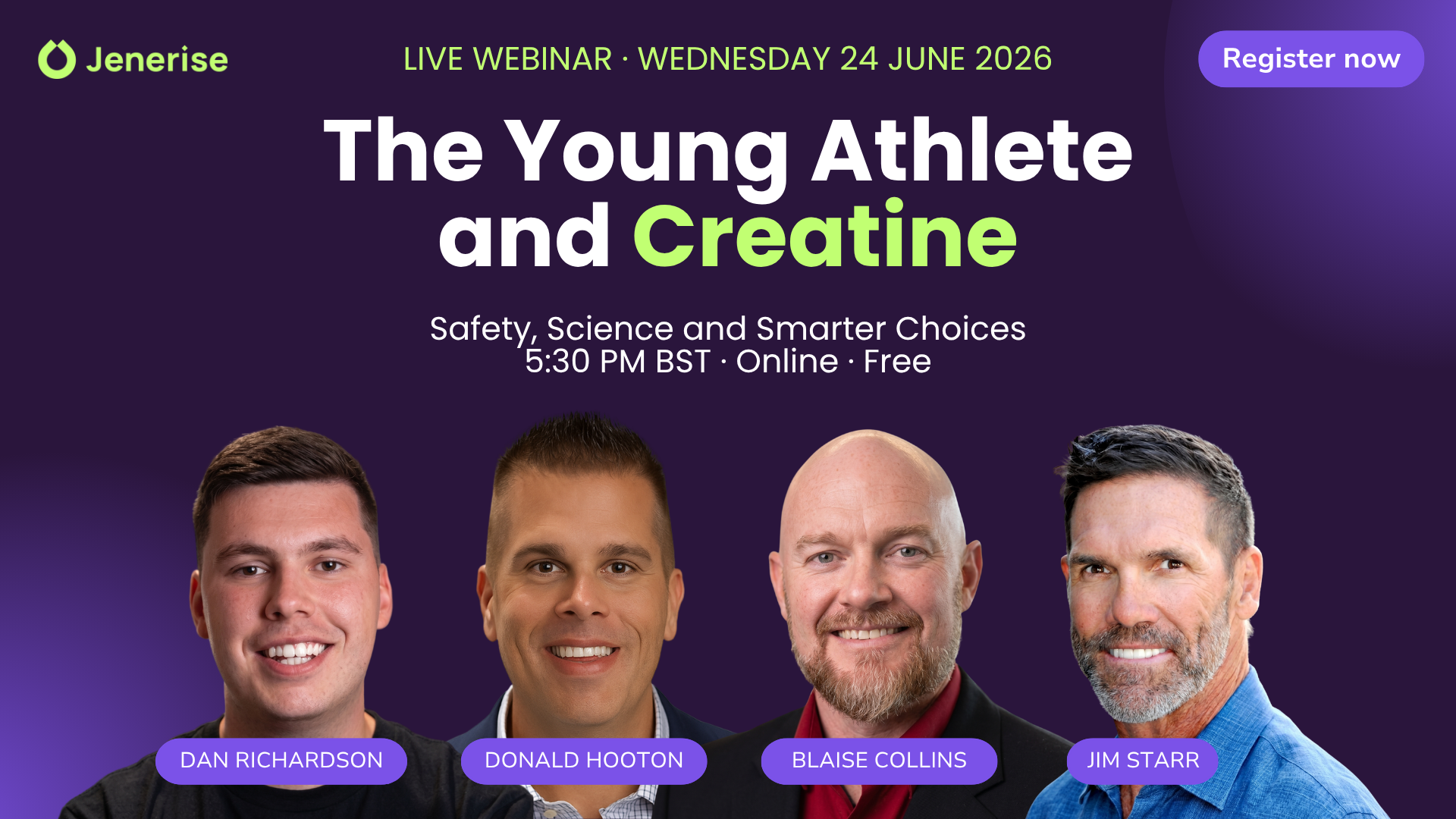
Join Donald and our other speakers for our upcoming webinar on Wednesday, June 24th.
We all rise together,
Rachael Jennings | Co-Founder + CBO, Jenerise