
Creatine and Menopausal Brain Fog

By Isabelle Statovci | Monthly Blog Contributor, Jenerise | Accredited Practising Dietitian & Clinical and Exercise Scientist
Brain fog is a limiting and frequently reported symptom during perimenopause and menopause, often altering daily cognitive efficiency and focus. Affecting up to two-thirds of women, it can significantly impact daily quality of life (Greendale et al., 2020; Maki & Jaff, 2022). Women consistently describe these subjective cognitive symptoms as word-finding difficulty, losing their train of thought mid-task, and attentional lapses during reading or conversation (Maki & Jaff, 2022). This has sparked growing interest in creatine as a potential non-hormonal support, driven by a sound biological rationale and early trial data.
While regulatory agencies like the European Food Safety Authority (EFSA) have concluded that broader evidence does not yet support an official brain health claim (Turck et al., 2024), researching creatine's bioenergetic role during the menopausal transition offers an encouraging frontier in women’s health.
The Bioenergetic Rationale
The brain demands significant energy, relying heavily on the phosphocreatine system for rapid adenosine triphosphate (ATP) replenishment. Because women naturally maintain lower endogenous creatine stores than men, and estrogen directly influences cerebral energy utilization (Smith-Ryan et al., 2021; Roschel et al., 2021; Forbes et al., 2022), the drop in estrogen during perimenopause may create a localized metabolic deficit.
Neuroimaging studies confirm that midlife cognitive complaints correlate with measurable shifts in regional brain energy metabolism (Mosconi et al., 2025). Additionally, preliminary cross-sectional data suggest perimenopausal women exhibit reduced brain creatine in areas governing concentration (Ostojic & Ostojic, 2026).
What the Clinical Research Shows
Direct clinical evidence evaluating creatine supplementation for cognitive outcomes in perimenopausal and postmenopausal women comes from the double-blind, placebo controlled, randomised controlled trial: CONCRET-MENOPA, which tested low-dose, high-solubility creatine forms in 36 perimenopausal and postmenopausal women over eight weeks, with 9 women per group (Korovljev et al., 2025) Menopausal women were defined as having no menstrual cycle for 12 consecutive months without other causes, while perimenopausal women were still menstruating but reported at least one symptom such as hot flashes, sleep disturbances, mood swings, or concentration difficulties. Researchers used advanced brain neuroimaging (proton magnetic resonance spectroscopy) in a subset of 16 participants (4 per group) to measure localised brain creatine concentrations and administered standardised cognitive tests to evaluate attention, processing speed, and inhibitory control.
The trial evaluated one main primary goal alongside roughly 50 supporting measurements grouped into six practical categories:
Main Focus (Primary Endpoint)
Mental Fatigue: Tracked changes in overall subjective brain drain and mental exhaustion using a standardised rating scale.
Supporting Measurements (6 Key Categories)
Brain Processing & Focus (13 measures): Computerised tests evaluating reaction speed, attention networks, and visual processing accuracy.
Daily Energy Breakdown (4 subscales): Detailed tracking of physical fatigue, daily activity levels, and motivation.
Physical Endurance (1 measure): Treadmill walking time until exhaustion to test physical stamina.
Menopause Symptoms (9 symptoms): Subjective severity ratings for hot flashes, night sweats, mood swings, anxiety, depression, concentration difficulties, sleep issues, headaches, and muscle aches.
Brain Fuel Deposits (13 regions): Advanced MRI brain scans measuring actual creatine accumulation across 13 specific brain areas.
Blood Chemistry & Safety (20 health markers): Lab tests tracking estrogen and reproductive hormones, inflammatory markers, cholesterol and triglyceride profiles, blood sugar, and routine liver/kidney safety panels.
CONCRET-MENOPA Clinical Trial Key Findings:
Click table to enlarge sizing.
What Else the Research Revealed
The trial did not meet its primary endpoint: Mental fatigue, the trial's designated primary endpoint, did not improve significantly in any group and showed no between-group difference.
Zero Weight Gain: Body weight remained stable across all groups, consistent with other creatine research showing standard supplementation does not drive fat or water-weight gain.
Well tolerated: No severe adverse events were reported across any group; a small number of participants reported transient heartburn (low-dose group) or bloating (placebo group) that resolved without intervention.
Not Monohydrate, Not Standard Dose: The trial tested creatine hydrochloride and creatine ethyl ester at 750–1,500 mg/day, roughly a third to a fifth of the 3–5 g/day of creatine monohydrate used in most creatine research. There was no monohydrate comparison arm, and no validated menopause-specific brain fog scale was used as the primary measure (Furey et al., 2025). Findings here do not translate directly to standard-dose monohydrate use.
Wider Research Across Other Settings and Populations
The broader literature shows that creatine’s impact on cognitive performance depends heavily on the brain's energy state at the time of supplementation:
Under Metabolic Stress: When the brain is under acute strain, such as severe sleep deprivation or low-oxygen conditions, single high doses of creatine help offset cognitive slowing, with female subjects often showing heightened responsiveness (Gordji-Nejad et al., 2024, 2026; Turner et al., 2015). Pilot work in clinical populations like Alzheimer’s disease also demonstrated global cognitive gains (Smith et al., 2025).
Under Normal Baseline Conditions: In healthy, well-rested adults or older individuals operating with adequate baseline energy, results are mixed or neutral (Alves et al., 2013; Sandkühler et al., 2023; McMorris et al., 2024; Xu et al., 2024). Notably, a separate study specifically in perimenopausal women found that while creatine improved muscle strength and sleep quality, it produced no measurable changes in cognitive performance (Hall et al., 2025).
Moving Forward
Perimenopausal and Menopausal cognitive symptoms remain an under-researched area where non-hormonal, safe options are needed (Spector & Gurvich, 2025; Smith-Ryan et al., 2025). While creatine presents a biologically plausible mechanism and promising early trial data, larger replication studies will determine its long-term place in clinical practice. Anyone navigating midlife cognitive changes should consult a healthcare provider for personalised guidance.
We all rise together,
Medical Disclaimer: This article draws on peer-reviewed and systematic-review literature in sports nutrition and pediatric sports medicine. The information provided in this article is for educational and informational purposes only and does not constitute medical advice. It is not intended to be a substitute for professional medical advice, diagnosis, or treatment. Always seek the advice of your physician or other qualified healthcare provider with any questions you may have regarding a medical condition.
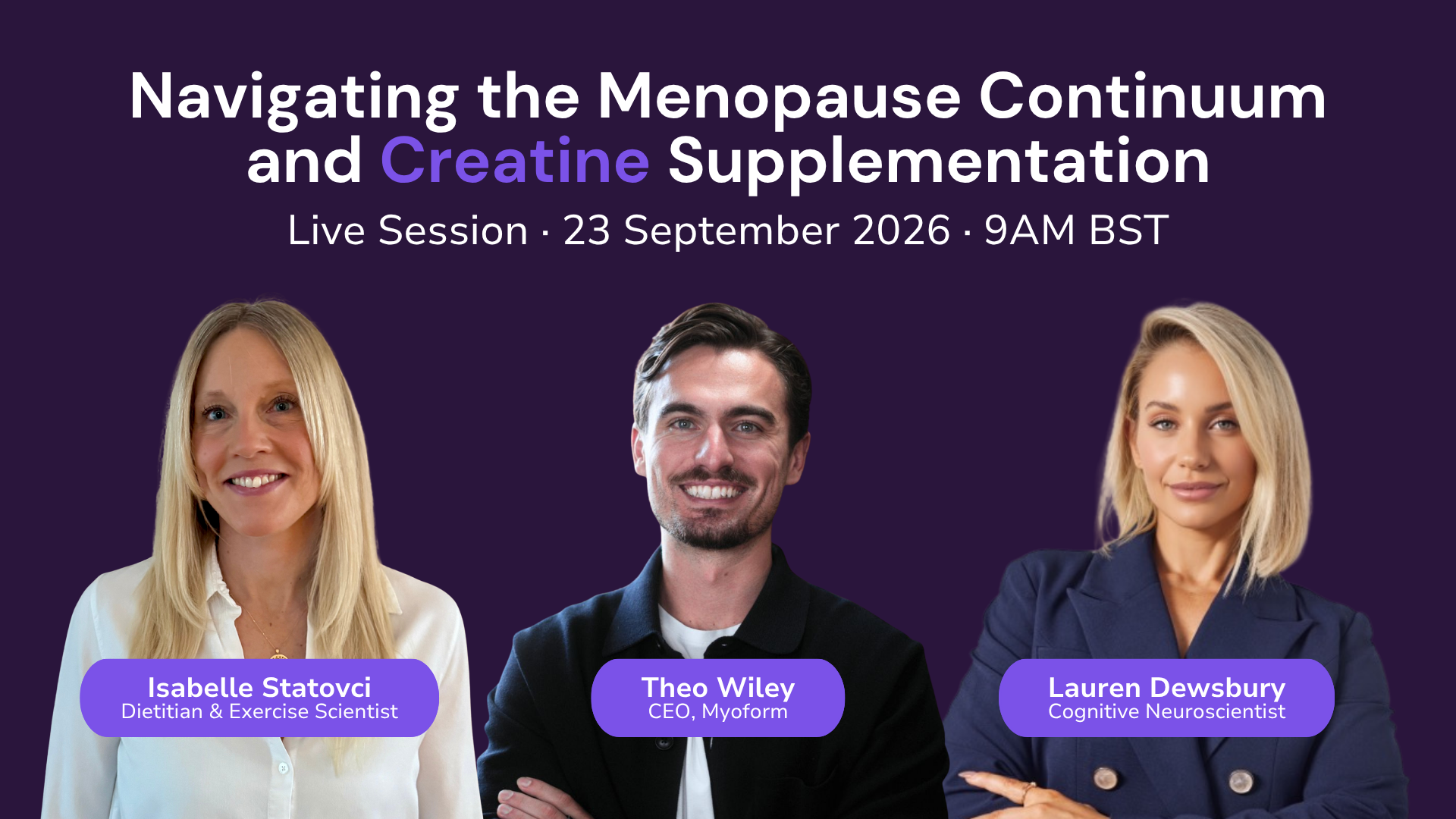
Catch Isabelle live on Wednesday, September 23 at 9:00 AM BST for our educational session, ‘Navigating the Menopause Continuum and Creatine Supplementation’
More articles by Isabelle



Frequently Asked Questions
Does creatine help with menopause brain fog?
A new study looked at this question directly for the first time. Some doses of creatine helped people think faster and focus better. But the study's main goal (reducing overall mental tiredness) did not improve more than a fake pill (placebo). So the answer right now is: maybe, for some things, but not proven yet.
What was the new study about?
Scientists gave 36 women in perimenopause or menopause either creatine or a placebo (fake pill) for eight weeks. They tested memory, focus, and reaction time. Some women also got brain scans to measure creatine levels inside the brain itself.
Did creatine cause any bad side effects?
No. Nobody in the study had a serious health problem from taking creatine. A few people had mild heartburn or bloating, but that went away on its own.
Is this the same creatine dose used in most other studies?
No. This study used much smaller doses (750–1,500 mg per day) of two special creatine types. Most creatine research uses a bigger daily dose (3,000–5,000 mg) of a different, more common type called creatine monohydrate. So these results can't be used to guess what the common type and dose would do.
Should I take creatine for brain fog right now?
Talk to your doctor first. This was a small, early study, not a final answer. It shows creatine is an interesting and safe option worth more research, but scientists need bigger studies before anyone can say for sure how well it works.
Further Reading and References
Alves CRR, et al. Creatine Supplementation Associated or Not with Strength Training upon Emotional and Cognitive Measures in Older Women: A Randomized Double-Blind Study. PLoS ONE, 2013.
dos Santos Quaresma MVL. Concerns Regarding the Methodological Rigor and Interpretation of "Creatine and Cognition in Aging: A Systematic Review of Evidence in Older Adults". Nutrition Reviews, 2025.
Forbes SC, et al. Effects of Creatine Supplementation on Brain Function and Health. Nutrients, 2022.
Furey RT, et al. Subjective versus objective cognition during menopause: A systematic review and meta-analysis. J Int Neuropsychol Soc, 2025.
Gordji-Nejad A, et al. Single dose creatine improves cognitive performance and induces changes in cerebral high energy phosphates during sleep deprivation. Sci Rep, 2024.
Gordji-Nejad A, et al. Single-Dose Creatine Reduces Sleep Deprivation-Induced Deterioration in Cognitive Performance. Nutrients, 2026.
Hall L, et al. Impact of creatine supplementation on menopausal women's body composition, cognition, estrogen, strength, and sleep. J Int Soc Sports Nutr, 2025.
Korovljev D, et al. The Effects of 8-Week Creatine Hydrochloride and Creatine Ethyl Ester Supplementation on Cognition, Clinical Outcomes, and Brain Creatine Levels in Perimenopausal and Menopausal Women (CONCRET-MENOPA): A Randomized Controlled Trial. J Am Nutr Assoc, 2025.
Marshall S, et al. Creatine and Cognition in Aging: A Systematic Review of Evidence in Older Adults. Nutrition Reviews, 2025.
McMorris T, et al. Creatine supplementation research fails to support the theoretical basis for an effect on cognition: Evidence from a systematic review. Behav Brain Res, 2024.
Moriarty T, et al. Dose-Response of Creatine Supplementation on Cognitive Function in Healthy Young Adults. Brain Sci, 2023.
Mosconi L, et al. Neurophysiological correlates of subjective cognitive decline in perimenopausal and postmenopausal midlife women at risk for Alzheimer's disease. Menopause, 2025.
Ostojic SM, et al. Brain creatine, estradiol and neurocognitive complaints in perimenopausal women: an exploratory cross-sectional study. Neurosci Lett, 2026.
Prokopidis K, et al. Effects of creatine supplementation on memory in healthy individuals: a systematic review and meta-analysis of randomized controlled trials. Nutrition Reviews, 2022.
Prokopidis K, et al. Author's reply: Letter to the Editor: Double counting due to inadequate statistics leads to false-positive findings in "Effects of creatine supplementation on memory in healthy individuals: a systematic review and meta-analysis of randomized controlled trials". Nutrition Reviews, 2023.
Roschel H, et al. Creatine Supplementation and Brain Health. Nutrients, 2021.
Sandkühler JF, et al. The effects of creatine supplementation on cognitive performance—a randomised controlled study. BMC Med, 2023.
Smith AN, et al. Creatine monohydrate pilot in Alzheimer's: Feasibility, brain creatine, and cognition. Alzheimers Dement Transl Res Clin Interv, 2025.
Smith-Ryan A, et al. Creatine in women's health: bridging the gap from menstruation through pregnancy to menopause. J Int Soc Sports Nutr, 2025.
Smith-Ryan A, et al. Creatine Supplementation in Women's Health: A Lifespan Perspective. Nutrients, 2021.
Spector A, et al. Differentiating Cognitive Challenges During Menopause Transition From Dementia: Key Considerations. Australas J Ageing, 2025.
Turck D, et al. Creatine and improvement in cognitive function: Evaluation of a health claim pursuant to article 13(5) of regulation (EC) No 1924/2006. EFSA J, 2024.
Turner CE, et al. Creatine Supplementation Enhances Corticomotor Excitability and Cognitive Performance during Oxygen Deprivation. J Neurosci, 2015.
Xu C, et al. The effects of creatine supplementation on cognitive function in adults: a systematic review and meta-analysis. Front Nutr, 2024.

Heavy legs one week, strong the next? Wellness feeds say to time your creatine to your cycle. Isabelle Statovci dug into the research to see what holds up, what is still just a hypothesis, and what to do with your daily scoop. Spoiler: keep it simple.