
Seizing the Years with Sigge Birgisson
"I think consult your doctor first and foremost. And if your doctor doesn't know about GLP-1s, find another one who does."
Sigge Birgisson came to Rachael's mic as someone who's lived it: the allergic kid who grew into the guy who wanted to eat the whole world, the software developer in Södra Sandby who got a checkup at 40 that gave him a wake-up call, and the father of two who, eighteen months later, is planning dive trips with sons who aren't quite old enough for the water yet.
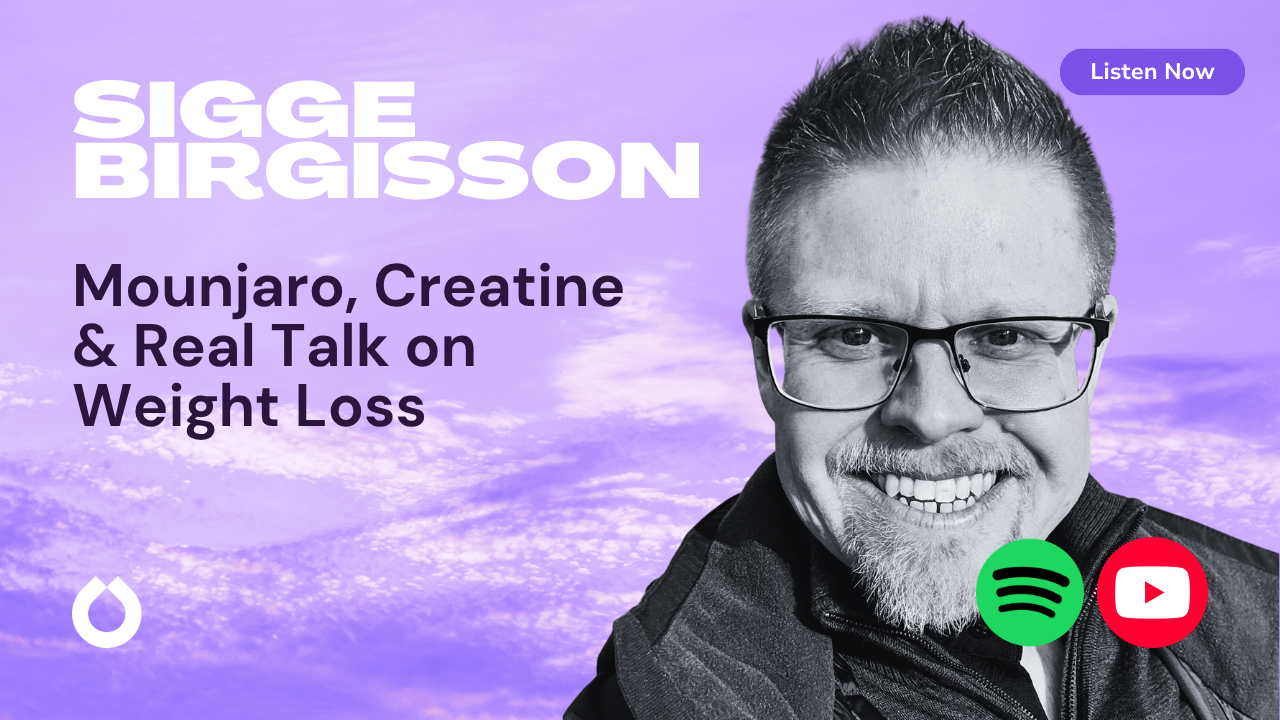
This month, Rachael sat down with an old friend from her teenage years in Sweden to talk about GLP-1s, the habits that actually made the medication work, and how supplementing with creatine found its way, almost by accident, into his morning bowl of quark.
A childhood of allergies.
Sigge grew up in Sweden with a list of foods he couldn't touch, the kind of childhood allergies serious enough that his mother once stopped a hospital nurse from handing him orange juice. At 15, a battery of skin tests cleared him of nearly all of it, and he was set free to enjoy food the way most kids take for granted. He describes those years as the moment he decided to eat everything he'd missed, and the extra weight that followed him into adulthood traces back to that joyful turn.
Sweden's 40-year checkup was the wake-up call.
Being overweight was never dramatic for Sigge. He ran races, stayed social, and never crossed into what he calls "complete massive obesity." But Sweden's public healthcare system runs a standard cardiovascular screening at 40, and his came back with a clear nudge to pay closer attention. Around the same time, a chest pain scare sent him to call an ambulance. He took it as useful information, started moving more with his sons, and cut back on candy. It helped, and it also showed him there was more room to grow.
Two friends, an app doctor, and a decision made on the 1st of April.
The real turn came from two friends who'd already spent six months to a year with a GLP-1 medication and told him, simply, to try it. His own GP hadn't raised it; GLP-1s were still new to Swedish primary care at the time, and coverage varied region by region. Instead, on his friends' advice, he went through a private telehealth "app doctor" that specialises in weight loss, ran the required tests, and got started on Mounjaro. It wasn't a joke that the date was April 1st. It was simply the day he decided to try.
The lowest dose, stretched the smart way.
Where some patients climb the dosing ladder every month, Sigge stayed at 2.5 milligrams for eight months before dropping to 2.0, where he remains today. He also found a more cost-efficient way to manage it: buying the largest 15-milligram pen and dialling it down to a quarter dose, stretching one pen across roughly six months instead of one. In Sweden, where weight-loss medication isn't yet covered by the country's high-cost ceiling the way most prescriptions are, that math makes a real difference; it runs him about 90 euros a month, paid out of pocket, and is worth every cent to him.
Rapid weight loss taught him two great habits.
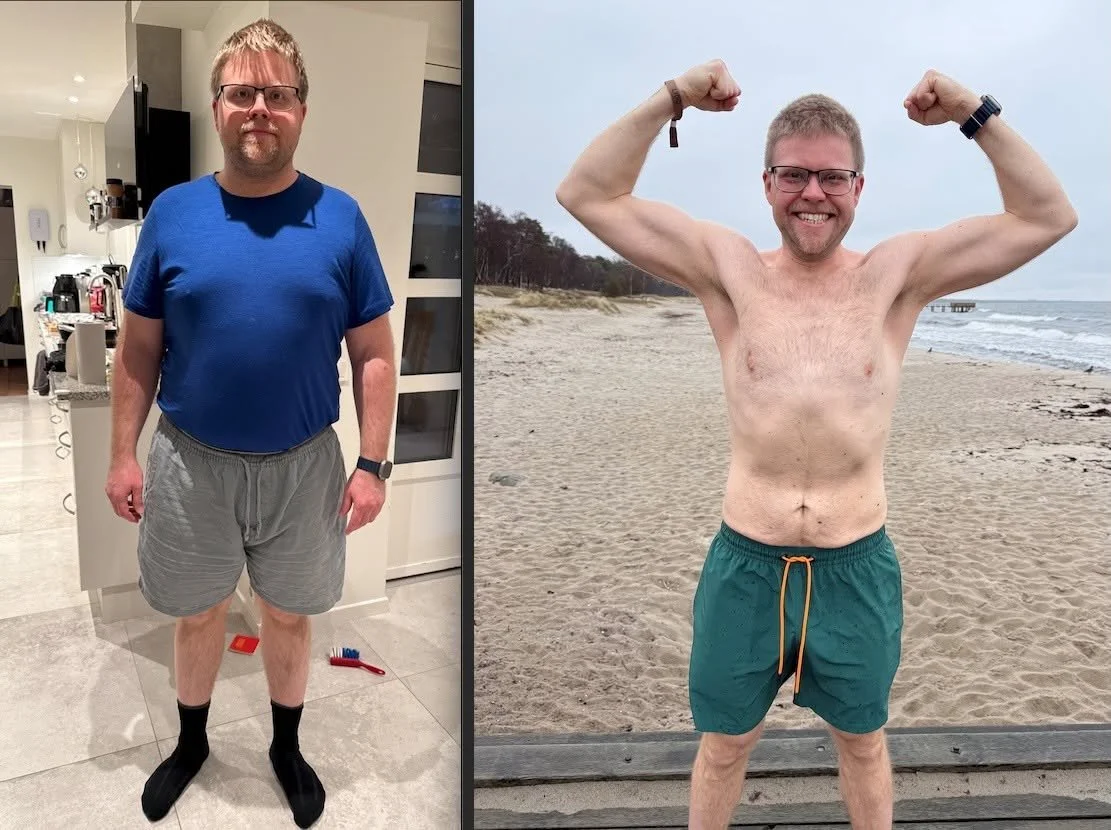
Sigge went from around 115 to 117 kilograms at his heaviest to 102 kilograms when he started the app doctor's program, and he's now been stable around 74 to 75 kilos for the past six months, feeling stronger than ever. Along the way, two lessons stuck. The first was strength training, to protect muscle mass during rapid weight loss (something he wishes he'd started even sooner, rather than waiting a month or two). The second was protein: learning that the target is roughly two grams per kilogram of body weight opened his eyes to just how much a plate of chicken actually offers, and pointed him toward regular protein shakes as an easy fix. He also picked up a smart scale early on, tracking muscle mass against fat mass rather than chasing a single number.
Supplementing with creatine was suggested to him through a conversation with ChatGPT.
Once the muscle-mass numbers started moving in the right direction, Sigge went looking for what else might help, and used ChatGPT the way he'd use a coach, asking what could support the strength training and protein work he'd already built into his routine. Creatine came up. He gave it a try, paused for a few weeks while he figured out that his hydration and protein intake needed adjusting, and then happily resumed supplementing with creatine once he'd sorted out the balance.
Quark, creatine, and a breakfast that finally stuck.
These days, Sigge supplements with creatine right at breakfast: a bowl of quark (Sweden's answer to Icelandic skyr), a scoop of psyllium husk, a splash of milk, and creatine stirred through, topped with whatever fruit is around. It's a habit that works precisely because it asks nothing extra of him: no separate scoop of water to force down, no prep the night before. Rachael shared her own version of the ritual: a protein-and-creatine "pudding" built the night before with yoghurt, chia seeds, and frozen mango left to soften in the fridge overnight.
Worth knowing: Jenerise makes Jenerise Cr.01™, a third-party verified, precision-grade B2B creatine ingredient. This content is educational and entertaining but also drives awareness of our product.
Seizing the years means diving trips with his boys.
Diving became Sigge's passion during his years in Australia, and it's stayed with him since. Now, with two sons (one nearly seven, one two) both enrolled in swimming lessons, he's building toward the day they can dive together. That, more than any number on a scale, is what Seizing the Years means to him in the middle of 2026: staying in great shape to do whatever his boys want to do, for as long as they want to keep doing it with him.
If Sigge's story resonated with you, you can find the rest of the season on Seizing the Years, along with the clinical team's deeper dives into the GLP-1 and creatine research on the Jenerise blog.
We all rise together,
Rachael Jennings | Co-Founder + CBO, Jenerise
FAQ
What is a GLP-1 medication?
A GLP-1 is a type of medicine that can help some people feel full faster and eat smaller meals. Doctors sometimes prescribe it to help with weight loss.
Can you supplement with creatine while using a GLP-1 like Mounjaro?
Yes, many people do. Creatine can help support muscle during weight loss, and it is a good idea to talk with your doctor about the right amount for you.
Why is protein so important when losing weight?
When you lose weight fast, your body can lose muscle as well as fat. Eating enough protein helps your body hold on to muscle while you lose fat.
What is quark, and why do people add creatine to it?
Quark is a soft, creamy dairy food that is high in protein. It is easy to stir creatine into quark for a quick, tasty breakfast that supports muscle health.
How much creatine should you supplement with each day?
A common daily amount is about three to five grams, but everyone is different. It is best to ask a doctor or dietitian what amount fits your body and goals.
More episodes







This month we have Sigge Birgisson on the show! A software developer, dad of two, and passionate diver, he opens up about his GLP-1 journey, losing over 40kg, and how supplementing with creatine and protein became the habits that stuck.